


I WAS FIVE IN in 1958 when Dad broke the news to Mom that he was being reassigned to South Ruislip AFB, England. She was pregnant with their fourth, and this would be yet another move while pregnant. But this wasn’t just another move; it was a transatlantic one, despite Dad’s promises that it wouldn’t happen again after my little sister was born in 1956. Just two years later, settled in base housing on Smoky Hill AFB, Kansas, Mom was pregnant again, and he had new orders in hand. Dad’s mother lived nearby in Wichita, and she looked forward to helping Mom recover and tending to her grandkids—the first opportunity for both women to be an extended family.
Mom urged Dad to apply for a waiver, for her sake and the baby’s. Other couples were doing the same. That was the first of many arguments between my parents.
Dad didn’t get a waiver.
That summer after we landed at London Heathrow, Dad’s immediate concern was to find a place for us to live. Within days, he found a house he hoped would delight and surprise us, especially Mom.
The brick manor house was right out of Architectural Digest. Dad, an embattled veteran of WWII and Korea, had once fancied being an architect, and the house was a glimpse of a future he felt worth the sacrifices.
Mom, a Japanese War Bride, had survived the Tokyo firestorm, starvation, the surrender, and American Occupation. They met and married at Tachikawa AFB in 1953, and I was born later that year.
Dad was committed to a better life for his growing family and for Mom. The rental house was his gesture of optimism, a vision of their future.
The British landlords needed a renter during their assignment in Australia. An American military couple with children seemed perfect. Regardless, Mom knew the rent would consume much of Dad’s tech sergeant salary and leave little room for extras.
Two miles from the main gate, the house featured a large fenced-in yard, an advantage for Mom at home with four kids. Dad would ride a bike or catch the bus to work—“No car payments!”
She gave up arguing with Dad about money. He would have a facsimile of his dream house, and we would have a yard for our adventures.
On the day we first saw the house, we left the hotel and clamored aboard the red double-decker bus bound for the village of South Ruislip with a short walk from the bus stop to the gated house.
When Dad pushed the gate open, we stepped into a mossy, cobblestoned courtyard landscaped with mature pines and junipers crowding the front steps and porch. My younger brother and sister and I skipped down the path, up a few steps to the house, and stepped into a wide, rectangular foyer with the living room, bathroom, and bedrooms tucked off it.
From the foyer, a wide-bowed, pane-glass picture window pulled the eye straight across to the dining room with a panoramic view of the backyard. Fruit trees bordered the neighboring fences. At the very rear of the yard was a glass potting shed the size of a small room and built entirely of framed, pane-glass windows—tired and aged, the house of glass windows had a pitched roof that sat on four walls with a single door. Close by was a swing set that caught my brother’s attention, but I zeroed in on the glass house. He and I began conjuring games of pretend, chase, and hide-and-seek. Hide-and-seek in a glass house!
The wide dining room window would tease us with its world of greeneries, rainstorms, fog, and animals unlike anything we’d seen in dust-bowl Kansas. Hedgehogs, moles, and fat, slimy slugs roamed at will in the yard. Trees dropped worm-infested apples and plums. And the summers meant buttercups and songs, strawberries and onions. It was a yard for children, ready with imagination and keen on adventure.
Shortly after moving in, Dad led us out the back door for a walk about. We assembled around the lawn chairs with a low table. The glass potting shed was behind us. To me, the shed was a puzzle of nine-by-eleven-inch windowpanes, each pane framed a different view, a kaleidoscope of broken colors.
I was already Big Sister to my brother and sister. And soon, there would be baby brother. We would be two girls and two boys, a forever foursome. As Big Sis, it was understood I was to be a model for childhood play and cooperation, and, if needed, contain chaos.
Using his stern sergeant’s voice, Dad said, “This glass potting shed is not a toy, not your playhouse. Do not lean on it, touch it, and do not walk inside or run around it. Do not play beyond the furniture. Jenny, make sure you keep your brother and sister away. Do you understand?”
One afternoon, as our parents lounged in the lawn chairs with friends and iced tea, my younger brother and little sister ran around the glass shed, and when they popped out the other side, unharmed. Perhaps it was okay to run around it.
Another time, my brother and I noticed the glass door ajar and wandered over for a closer look. When I peeked inside, a pungent, rancid odor watered my eyes. Two rotted wood benches were shoved against the sides, the rusted nail heads jutting. It was a sad, neglected place where spiders parked next to dead bugs. Broken clay pots and corroded tools lay strewn across the dank concrete slab like abandoned toys. My brother tried to muscle in, but I held him back and shook my head. “No, it’s creepy.”
We left without touching glass, technically. We weren’t hurt and we kept our secret to ourselves.
A year later, on a fall morning in 1960, we woke to a blustery Hundred Acre Wood day. Dad had been at the office for hours. At the breakfast table, we found Dad’s cold, uneaten toast in the silver-plated toast rack. We hurried to dress and as soon as breakfast was over, Mom told us to play inside before she escaped to her bedroom.
We stood at the big picture window and watched the storm. Barren tree limbs thrashed and whipped under a sunless sky. Round and around the wind in the naked canopy rattled and shook as though stirred by witches’ brooms. The frenzied wind sounded like jet engines and overwhelmed us—that wild power. My brother and I danced and jumped about the younger ones, pretending to be those trees.
Baby brother stood at the window. Small, chubby fingers pressed onto the windowsill, turned white from his grip, and waved his arm like a chimp stomping his feet, ready to stumble-run after us.
He raised his arms and demanded, “Up! Up!” I lifted him into my arms, and we spun in circles until I was dizzy.
Suddenly, an awful bang cracked through the air, the winds clawed the trees. The shed of glass trembled and debris circled like ravens over the yard. The glass door began bouncing off its frame like a gremlin with a mallet—drumming its glass skin.
How many times would it slam like that before it flew off its hinges or shattered in place?
I wanted it to stop. Something needed to be done.
I shouted, “Who will shut that door?”
Consumed by the delusion of play, that morning, I conjured Mighty Mouse and my four-year-old brother joined me. I thought our story would be written like this: the mouse swoops in, saves the day, and we celebrate with a parade and cake—an ending fit for children. An ending where we are celebratory, brave, and safe.
We called out to Mighty Mouse, chanting, “Mighty Mouse! Mighty Mouse!”
Mighty Mouse: rocketing down out of a blue sky, muscled arms grabbing the door to latch it shut.
My brother dashed out the back door, jumped off the red-brick porch, leapt down the steps, took off past the bed of red roses, and charged downfield. He ran as I’d never seen him run before. As he neared the glass shed, he raised his right arm—Mighty Mouse taking aim, fist clenched tight. We cheered with unbridled glee and clapped harder.
The wind caught the door and swung back as though it were a sword swinging for my brother’s hand. He flexed his wrist to stop it. I could not see what happened between the door and his wrist. But suddenly, he spun like a top and was running with such vigor I sensed something wrong. The door kept banging. Even then, we cheered and clapped.
When my brother burst through the side door, his face was a contortion. His mouth, a frown so exaggerated that I am recalling it as the Greek mask of tragedy.
As my brother darted by, his leather Buster Browns barely touched the ground. He was wailing. “Mommy! Mommy!”
His cries echoed, and that glass door banged and banged. Mom was in the bedroom. Silence and then, I heard her utter, “Oh—no.”
The toddlers held onto me. Something bad had happened. And they knew it. And I knew had a part in it.
When Mom appeared from the bedroom, she had hold of my brother’s right wrist, his arm hoisted in the air, and she pulled him past the dining room into the bathroom.
Her voice was practically conversational. The faucet shrieked but did not muffle my brother’s cries as water gushed into the ceramic tub. Her voice echoed through the bathroom, but she was calm and did not stop what she was doing. He wailed louder. The cacophony shot into the foyer, through the house, through me. Worse than the gremlin drumming on the shed. More wicked than witches with their brooms. In the dining room, all we could do was listen and flinch, waiting for her instruction. I wanted a reprieve. My stomach soured, true with shame. I wondered if I should walk to the bathroom to help.
The faucet shrieked again. She pulled the rubber stopper, and it made a familiar pop. Water gurgled. The tub was draining. The nightmare bath had ended.
They emerged and headed for the front door. My brother, whimpering. Mom kept her grip on his wrist and hoisted in the air as they shuffled to the black Bakelite telephone.
With her free hand, she grabbed the receiver and pulled it to her shoulder from the small, elevated shelf next to the front door. She bent her ear to it, dialed Dad’s office with her free hand. That morning, he was at his desk instead of the vault or the briefing room.
Meanwhile, the gremlin at the door made no sound. A pea-soup fog was engulfing London. Ground visibility: zero. No one would be driving in that fog.
I heard her, “Yes. Yes—come now. Hurry!”
After she hung up, I walked slowly toward the foyer, siblings in tow.
She saw us, and said, “Jenny, go to your room with your sister and brother. Close the door.”
Hearing my name seemed assuring, she sound mad, yet. But that dark, sour dread returned: something I conjured had caused something terrible.
Mom stood in the doorway, leaning against the jamb. Her fingers, still handcuffed to his wrist, made her a human tourniquet. My brother quiet, strangely calm. I did not see blood or tears. The two made a single silhouette staring into the fog.
We delighted when our brother turned his head to look our way grinning like a Cheshire cat. We returned the smile. Then, as a bonus gesture, waved his left hand, flopping it up and down a few times like a rocking horse. We waved back. I wanted to run and hug him. We were four again, and whole.
My younger sister and the baby pressed against me. We craned our necks so we wouldn’t miss another moment. She stood in the doorway, quiet and distant. Was she thinking, Who would rescue me?
How did a television cartoon hero’s story overtake me and awaken my brother to an identity he liked: hero, knight. The injury was a doorway into his real-life childhood, a story he began by peering through a looking glass, the preface I conjured, a delusion.
As soon as Mom heard the ambulance blaring, she pulled my brother into the courtyard, and we scurried to the doorway to watch.
The front gate opened and Dad stepped out of the ambulance. He looked handsome and sharp in his starched uniform, as if he’d just stepped out of Air Force Magazine. His smile offered calm. My brother grinned wide when he saw Dad and we smiled too. Dad was home with the ambulance. Yay! Now he was Mighty Mouse. The driver behind the wheel stayed there. The medic, too, stayed in the ambulance, expecting a little boy to hop inside.
But as Mom closed in on Dad, she was not smiling. Mom was near collapse. She pulled my brother, his wrist over his head toward Dad, and waved it, shouting,
“Here! Take it—here!”
As she thrust the wrist into Dad’s hand, she barked, “No—grab here! Take it! Take it! Hurry! Go! Go!”
Dad tried to catch hold of his son’s hand, but before he could grab it, Mom let go, pivoted, and ran back to the house.
Dad reeled backward as blood sprang high into the damp air, splattering across his face leaving crisscrossing trails up and down the front of his khaki uniform, on my brother’s face, and he began screaming.
The medic catapulted to the curb, grabbed my brother, and put him into the ambulance.
“Sarge! Jesus, man! Hurry up! Get back here. Let’s go!”
The ambulance, sirens blaring, cautiously drove into the fog and disappeared. Mighty Mouse had not saved the day. I wanted to disappear into the fog.
On the phone, Mom was unable to describe my brother’s wound. Her thoughts were racing in Japanese, struggling to find English words and no time to ponder meaning and nuance. Yet even if English failed her, her survival instincts and skills did not. The wound triggered her adrenaline and she knew to grip his wrist precisely and tightly to stop further blood loss through the strength of her fingers. She knew where and how to press! Who knows such things? The neurosurgeon who performed my brother’s surgery was awed and credited her skilled action for saving my brother’s life. She would not have told him she survived Tokyo 1945.
The medic, too, kept my brother alive through the hour-long drive to Burderop, the nearest military hospital able to treat him. As my brother was wheeled into the ER, a renowned British neurosurgeon was touring the children’s ward, and when he heard about the pediatric emergency, he decided to perform the surgery himself. He was also a World War II veteran. His specialty was amputation and limb trauma—repairing severed veins and nerves of wounded soldiers. He labored over my four-year-old brother for eight hours suturing veins, arteries, and nerves—groundbreaking surgery, a case that was eventually published in the British Medical Journal.
After the ambulance left, Mom called us to the dining room. She pulled up a chair at the table, and we huddled around her.
“Your brother might die or lose his hand.”
I remember that well and thinking if his hand were gone, we’d play anyway. But, if he were gone, there would be a blank everywhere I would otherwise see him.
She ran a hand through her hair and finally looked at me, “What happened?”
If Mom struggled to translate her thoughts into English, I couldn’t find words for my story. My body felt cold.
We were playing Mighty Mouse like the cartoon, but it was a horror show.
I mumbled, “We were pretending like Mighty Mouse . . . and the door was banging and we wanted to stop it, so he ran outside.”
She shook off my answer and with a flick of her hand, waved me off as if it meant nothing—as if I were a child like my little sister. I was six going on seven years old.
The back door was still open. Mom walked out to the porch, grabbed the garden hose. The faucet squealed as she turned on the water and pointed the nozzle down at the porch, at the blood, washing it into the bed of red roses, the stems standing tall, in full bloom.
I watched the red lake fade and stream and waited for her reassurance—but she was unable to give me that. Her thoughts displaced. I did not know. Somewhere I could not follow. She did not want to be found. She was not ready for me to find her.
We hardly spoke of the accident; if we did in the years that followed, it was only because I asked questions. Just the facts about the wrist, pressing it, and the surgeon. The mother and son separation. Other than one or two brief exchanges, no other time did we talk about it. Not me, my brother, or our parents. The two youngest don’t remember the storm, or the ambulance, and my sister hardly remembers the yard. For them, there is no memory or grievance to work out.
My brother and I, once so close, never spoke of it, even now, decades later. He survived: the accident, the surgery, three years of relentless physical therapy, and countless follow-up appointments. Dad asked to be reassigned to Travis AFB, outside San Francisco where the military hospital was a major research center able to monitor and supervise my brother’s rehab. Eventually, he regained full use of his right hand except for his pinky finger. The nerves and tendons were too tiny to be surgically repaired. But when he was healed, his lame pinky became a puppet monster to tease—growling and chasing after us around the backyard of our tract house in Northern California.
I no longer raise the memory with my siblings. My brother does not want to pick old wounds. This is my story, my exhumation, alone.
While my brother skirted death and maiming, the accident was our family’s tsunami, a wave seeming to disappear to the horizon only to be amplified by the distances traveled, the depth of the rift. When the ambulance left with him, none of us knew what to expect.
Ninety days passed between the ambulance leaving our house and his surgeries, post-op, recovery, and my brother’s release. In that time away, the Chief Surgeon directed my brother’s transfer to a critical care hospital for observation and specialized care. His body was whole, but his wound, the separation, intense rehabilitation, and the attention he garnered, surrounded by specialists in wound and recovery, left our family adrift and wounded. The distance between my brother and mother never healed. While Dad received time and military flights to see his son, Mom only saw him a couple of times in ICU recovery and once during his hospitalization.
When Dad brought him home, he was a brittle boy, as fragile as the shed. No more cavorting, chasing, kicking the ball at each other, or hide-and-seek for fear of disturbing his sutures and risking another bleed. Fear haunted me as I figured out quiet games and watched out for him; the bandaged arm became the thing we steered away from.
The question Mom posed in the dining room lingers: “What happened?”
It was a question I’ve been trying to sort out myself.
I enjoyed being the responsible one, having my parent’s trust and confidence. Being a playful Big Sister was easy and fun. When the ambulance left, I felt myself a troublemaker.
And Mom had no explanation for herself or Dad or the doctors. As a mother, myself, I wonder whether she was cast as negligent, leaving young children in the care of a six-year-old?
Most summers, I enjoy the garden outside my window. I can see all of it from my desk. The ruby-throated hummingbirds dart in and out of magenta bee balm, feasting on the nectar until the petals wither and sag, used up after the ravaging and frenzy. I do not lament the sacrificial season. After all, hummingbirds have miles yet to travel. And from my desk, I think of those days when a glass house stood in a beautiful yard, where everything is wild and nothing protected.
What I would tell my mother now is we were children, young and bored, and she was elsewhere in the house, caring for herself for a few moments.
About the author:
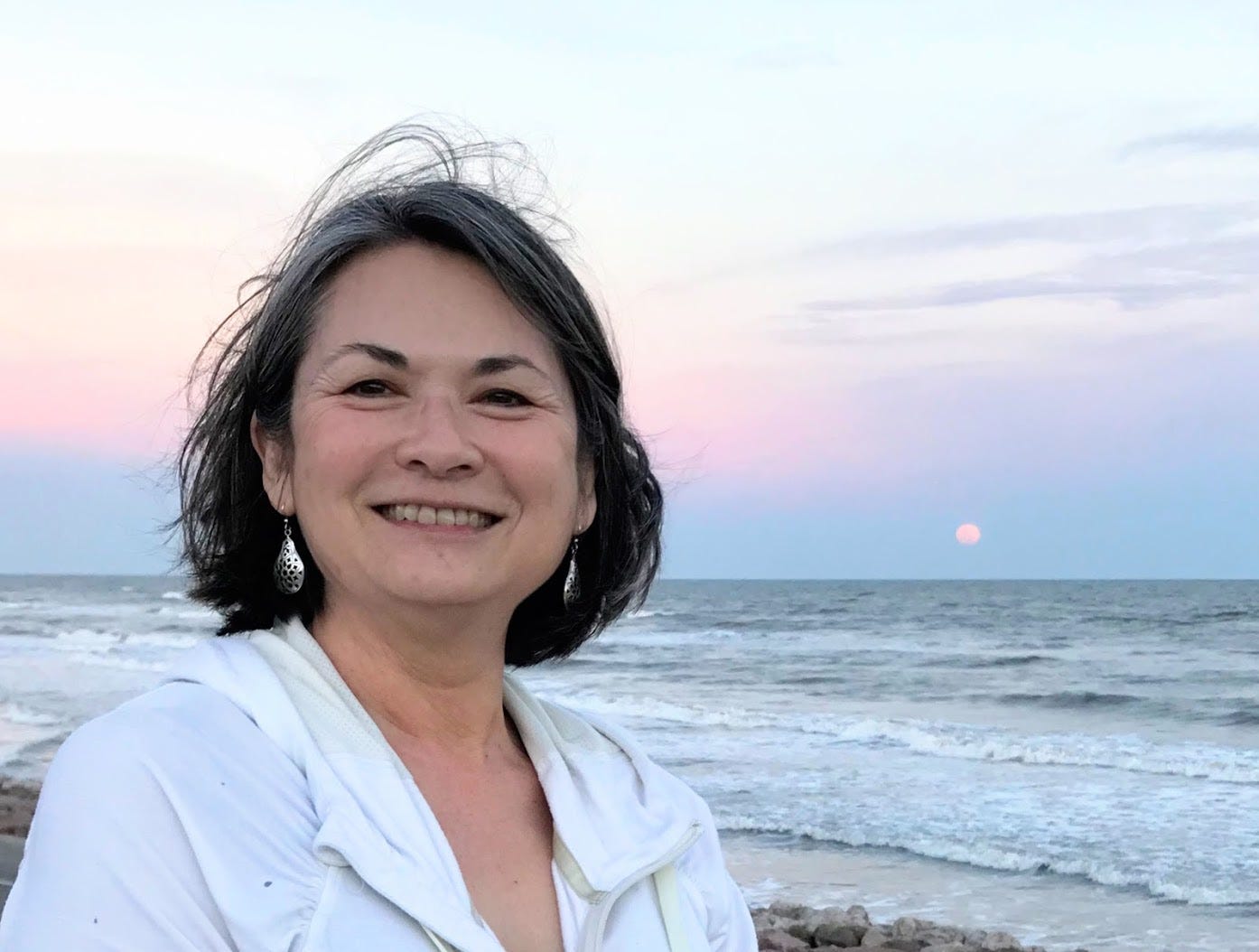
Jenny Linn Loveland is an award-winning artist, writer, and teacher born in Japan, with military roots, and for the most part hails from Fairfield, nestled in the foothills and colors of Northern California. The Potting Shed is excerpted from her upcoming memoir, Calrose (working title). She is a retired Air Force officer and Gulf War veteran. She is a Pushcart-nominated poet whose poems exploring PTSD have been widely distributed and featured in several publications. Find her artwork here.
What a rich and moving story. Thank you, Jenny.
Jenny this is a heart stopping, drenching story, especially the swinging sword. Thank you....