


ONE MORNING, nearly twenty years ago, a PG&E crew drove down our gravel road and parked the white bulk of their utility truck beside the barn. Three men emerged, and one of them, with a clipboard in hand, said, “We’re here to take down trees.”
“I thought you guys were going to let me know before you came.”
The man with the clipboard introduced himself as Frank. He was thirty-something, balding, with a paunch, and his two co-workers were younger, one small, lithe, with coiled muscles rippling his arms, the other softer, broader, a friend of beer and television.
“We could come back,” Frank said.
“I would like that,” I said, unapologetically.
“We just need your signature to remove these trees.”
Frank bent his arm to support the clipboard for me to sign. He handed me a ballpoint pen. He didn’t know the mis-beat of my heart as I signed my name to the trees’ demise. He informed me that crews would begin their tree-felling work within just a few days.
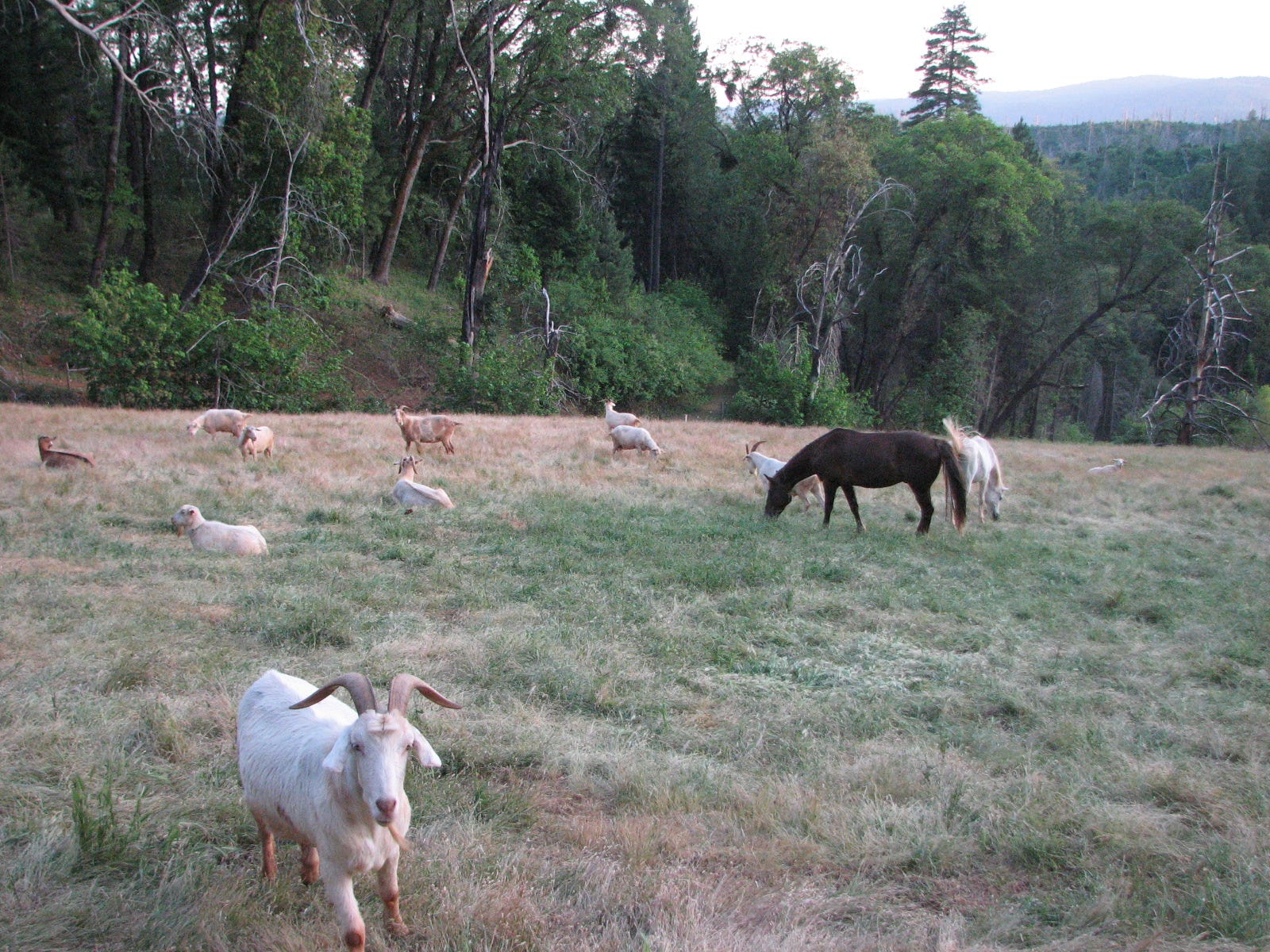
Two days later, Justin, one of our guardian dogs, went missing. For five years, Justin and his partner Juneau had guarded the small herd of goats from the mountain lions and bears that live in these Sierra Nevada foothills. He was Akbash, an old breed from eastern Turkey. Reserved and independent, he was gentle with people but fierce in protecting his flock. Justin looked like a giant white Labrador Retriever, whereas Juneau was a long-haired, thick coated Great Pyrenee, originally from the cold, high mountains straddling France and Spain. She was devoted to Justin. He had looked after her since my partner, Teresa, and I brought Juneau home as an inexperienced pup.
During the previous evening, the goats and dogs got out of their pasture. I was able to get the goats back inside, but when this happened before, my dogs had taken advantage of their freedom to explore beyond the perimeter of the fenced enclosure. I figured they would return by morning, because they always did, eager to get back to the job of guarding their flock, but when morning came, Juneau lay alone and bereft with her head on her paws.
It wasn’t like Justin to abandon his post.
The sun was just rising. The words Death in the east whispered in my mind. And I corrected myself, thinking, No, the east is not the place of death but of new beginnings, the place of rebirth, resurrection.
I drove several miles to our small town of Camptonville so I could put up flyers at the post office, the general store, and the forest service station, hoping that someone might have spotted him. Maybe he had run off a cougar in the night, had gotten lost, and was still searching for his way home.
Nobody had seen Justin.
I’d been seeing a raven lately. Ravens used to be rare in these parts. Opportunistic and smart, maybe they were moving away from disrupted ecosystems in their other territories? Now they were making their homes on the margins of our fields and forest, raiding the hawk’s nests and harassing their flight. The flinty invaders would double-team and dive-bomb the hawks, constantly squawking and conquering the air, claiming the territory.
The morning after Justin disappeared, a raven landed on the fence and eyed Juneau’s breakfast of dry dog food. The raven’s scruffy black feathers shone with a purple luminescence in the sun.
This raven eyed me for an uncomfortably long moment, then cawed three times. I remembered that in shamanic traditions raven is a messenger between worlds. Maybe you’ll help me find Justin, I thought. But I was too rational to believe this would happen. Besides, this raven had only shown up for a free meal, which Juneau had no intention of sharing. As the raven moved toward her food, Juneau made a quick charge, baring her teeth and releasing one short bark. The raven lifted into the air and flapped away, toward the forest.
The day after raven’s visit, my morning meditation was filled with the sound of chainsaws severing Ponderosa pines from their roots. Men with orange hard hats were on the move, chainsaw blades swinging like extensions of their arms, hands gloved and ears muffled against the throatless growl of their machines. The cacophony moved closer. A shiver trembled through the earth.
I climbed down the ladder from my meditation loft, carrying an abalone shell and stick of sage for smudging and blessing the trees, and walked into the field beside my house. Here, on the land that is my home, the PG&E lines end their long march through miles and miles of the Tahoe National Forest. I live at the end of the line. Two trees there leaned dangerously toward the high voltage wires.
Nine years prior, just a quarter mile up these very lines, the wind blew the top from an old gnarled pine which came crashing down on those coiled conduits of energy. Flames sparked and fire spread through the dry October grasses and Manzanita patches. The parched, low-lying brush became ladder fuel for the fire to climb the crowns of Sugar and Ponderosa pines, Douglas and White firs, cedars, madrones and oaks. Consuming everything in its path, the fire licked up the trunks of trees, burned through underground roots, through holes of mice and moles, through the deer beds and the bear’s lair, through breeding grounds of lady bugs and nests of yellow jackets. A fox with burned paws had limped through this very field, exposed and in shock. Helicopters chopped through dense smoke. Firefighters in yellow coats, faces blackened by ash, fought the massive flames.
But now I stood in the field below the power lines, holding the abalone shell that cradled the smudge-stick of sage. Facing east, I acknowledged the power of fire. Turning south, I remembered my grief. Turning west, I recalled the charred and blackened landscape. Facing north, I remembered the long winter of my loss. I looked toward the heavens and asked forgiveness. I looked towards the earth and asked guidance. I looked within and listened.
Where was Justin?
I approached a pine tree that had been marked by the PG&E crew with a red spray-painted X. This tree was one of the biggest in the pasture. Twenty feet up her trunk was a wide scar, as though punched hard in her belly years ago and forced to bend over for the rest of her life. In a high wind, this old wound could break her. I lit my smudge stick and sent up wisps of smoke, blessing her, and placed my hand on her coarse bark, sensed the pulse of this life soon to end. I could see in my mind the trees all along the miles of electrical wires, thousands and thousands of them, falling now, sacrificed to power. I had made my own Faustian bargain—for fire protection, yes. But also, for power protection—so that I could have electricity. I listened to the pine and the wind sighing in her branches. I listened to the cry of a young hawk recently flown from his nest. I looked through the pine boughs to the power lines flowing with the blood of the marked trees and with the blood of whole forests. I offered my sacrifice as well, these few trees connecting me to all the trees sacrificed in this age to power.
Our homestead is situated at the center of our 200 acres of forestland. A mile of graveled dirt road and three more miles of narrow cliff-hugging pavement connect us to the outside world. The fire had burned through all but twenty acres of beloved forest. The firefighters, the winds, and the numinous powers had somehow conspired to leave the buildings intact, along with a circle of green extending down to the creek and across the canyon where the fire did not burn quite so hot. But on the ridge top and the slopes, the flames had taken everything.
Across the road, my goats were doing their work to control the burgeoning underbrush. They kept down the fire danger with their voracious appetite for young ceanothus, berries, thistles, and all the ferocious growth thickening across the land since its denuding. A deep pang of loss troubled my heart to see only Juneau there in the pasture. I remembered how, when the goats were threatened, Juneau and Justin would gather the mob in a tight circle. The goats would huddle, rumps toward the center, ears pricked, eyes fixed on their protectors. Justin and Juneau, with hackles raised, would place themselves between the vulnerable little herd and whatever scented menace eluded my human gaze. It may have been a lion they were sensing, or a pack of roving dogs. We had had tragic kills by both in the past.
I went in search of Justin.
The road curved around a ravine to the east side of its ridge. From here the buzzing saws of the PG&E crews became louder, more intense. My mind moved darkly toward the men wielding their saws and beyond them to the corporation they served. I kicked a rock out of my way and saw my black boots scuffed and covered with red dust. The rock scuttled a few feet down the road, came to rest near a clump of orange California poppies.
I began to chant. Hatred will never cease through hatred. By love alone, by love alone, by love alone will it end. The words come from an ancient Buddhist scripture. The chant took hold of my thoughts. I plucked one of the poppies and brought it to my lips and spun the petals across my mouth and beneath my nostrils. A light breeze lifted my hair. My eyes misted.
Justin, where are you?
I made my way back through rocks and poison oak toward the power lines. Ten feet on either side of the poles was cleared each year of brush and hazardous trees by the utility crews. I hated to see the trees felled. But a fire could take a whole forest. I hated to see these intruding lines of the oh-so-human world soldiering through the wild woods. I hated the saws and the giant yellow machines that snaked the felled logs out of the woods, gashing the earth.
I continued to chant softly, looking down the length of my blue-jeaned legs at the dry pine needles and fallen oak leaves crunching under my boots. Mature Ponderosa pines rose up on either side of me. Since the fire I had protected these trees. They were at risk, too. They were close to the electrical wires and already scarred by the careless logging that happened after the fire in 1999.
I felt such sadness. The chant on my lips united my sorrow to losses across the planet. Hatred will never cease through hatred. By love alone is it healed. This is an ancient and eternal law.
I breathed deeply, but breath stuck in my throat. I thought again of the raven I had seen.
Strange how you come back to me now, I thought, remembering her penetrating eyes and feeling undigested pain in my chest.
Something startled and flew up from the brush. I followed the sound with my eyes until I located the source. I stopped. An eagle-sized bird with a naked red head looked down at me from a pine tree ten feet away. He was perched on a solid bough fifteen feet from the ground. I looked up at the bird while it stared back at me. You’re not Raven, I told the bird, but you’ll do as a stand in. My voice broke the silence and another vulture flapped into sight. The grey-brown buzzard landed and came to rest in a tree directly across from its mate.
I was less than a quarter mile east of my house. The east is not the place of death but of new beginnings, the place of rebirth, resurrection. There, beneath a scrubby Madrone tree, lay Justin’s magnificent white body. His belly had been ripped open and a grayish green rope of gut and intestine rested against his back legs. I pressed my fingers against a deep puncture wound on his chest. There was a gurgling sound, and I jumped back on my heels, struck with the impossible hope that, somehow, he might still be alive.
I wondered if it had been a long, drawn-out dying, alone in the forest as I slept so near. If only I had found him sooner! I knelt on the earth, stroked Justin’s face and the soft hairs on the top of his nose. I massaged the soft flap of his ear and exhaled a tender breath into it. If only I had heeded Raven. If only I had listened for the meaning—death in the east. If only . . .
I took Justin’s head onto my knees. It was then I understood the mortal blow delivered to his skull: final, fatal and immediate. Blood, sticky and thick, clung to my hand, dampened my blue jeans, stained them an inky black. I saw it as clearly as if I had been a witness: the powerful swipe of the bear’s great claws, slashing clearly, cleanly, across the left side of Justin’s face.
Until that moment I had felt oddly subdued, as though I was standing outside myself, observing myself touching Justin and analyzing the scene of his battle. Then, I took my dog’s front paws into my own two hands. I felt the give of his calloused pink pads, traced his strong nails with my fingers, stroked the coarse hair on the top of his feet, and felt the bone beneath, the tendon, the dear life so recently flown. I held his paws tightly, tenderly, and tears began to come, streaming down my cheeks and into the ground. Once they came, I felt they would never stop.
Under the patient eyes of the two dark birds, I cried for Justin— his sweet amber eyes, his brave and gallant spirit. I cried for myself and for the mortality that bound us. I cried for my lack of presence, for life neither totally seen nor totally lived. Through my tears I slowly stood, again lit the sage I still carried, and reverently smudged Justin’s body. I prayed his spirit would be free and happy. Looking to the east, where the sun rises, I sang a broken chant. I turned to the big pine standing close by, threw my arms around its wide, solid girth, and wept.
Time slipped away. I slumped to the ground, my back against the coarse bark of the Ponderosa pine. I was washed by my tears. I looked down at the blood on my hands and at the stained denim of my knees. The wind had come up. It blew right through me as if my body were a hollow reed, an Aeolian harp for the breeze to play. Now I was space. Now I was blue sky. Now I was the soft sighing amidst the tops of pines.
The image of Raven glided through my inner vision, riding on the currents, circling, spiraling nearer, eventually landing on the very branch where I had first spotted the vulture. Once again Raven fixed me with his gaze—knowingly, maybe even lovingly, maybe even wise. He seemed to gaze at me from a deep, ancient, place—a place more ancient even than death itself. If that were possible, I mused. As though reading my thoughts, Raven spread his wings and with a slight bounce lifted into the air. With a graceful descent he glided down toward Justin’s body. But the dog’s body was no longer there. Raven landed where Justin’s body should have been. He gazed slyly at me and in my mind I heard: Why do you look for the living among the dead? I watched, then flung my thoughts at the bird: Are you mocking me? Raven spread his wings, turned in a full circle there on the earth as though deliberately dancing on Justin’s grave, then lifted suddenly and flew away.
I started, as if awakening from a dream. I looked towards Justin’s torn body. It was still there. His blood was still on my hands and jeans. I stood slowly and brushed the forest litter from the seat of my pants, turned for a moment to look at the tree I had been leaning against. Just above eye level, I noticed claw marks. The bark was freshly torn for a long way up the trunk where the bear had climbed into this tree. I looked up toward the first limb that might have born the bear’s weight and saw that it had been broken. The remains of a jagged branch hung a couple of feet out from the trunk. Justin had treed this bear. The branch had given way under the bear’s great bulk. Had the bear fallen toward the barking dog? If that were the case it would have had no alternative but to fight. Justin had known this bear well, for it had visited outside the perimeter of Justin’s territory many times in the night. Probably it had taunted Justin. Bear and dog had been worthy adversaries, each keeping the other alert. Justin had found his chance to chase this bear out of his territory for good—away from the constant threat to Justin’s vulnerable flock. Instead, Justin had sent the bear up a tree. When the fight was upon them, Justin had given his life.
Given his life . . . I stared at Justin’s still form. You gave your life protecting what was yours to protect. I spoke to him now as though he was standing in front of me, looking at me with his kind, light-filled eyes. His eyes were different than any dog’s I had known. Other dogs had nut-brown eyes, the color of almonds. Justin’s were amber, the translucent yellow-orange color of resin from the heart of ancient trees. My good, guardian dog, I whispered to him. My good guardian dog become guardian spirit. I spoke these words softly and felt the truth in them like finding solid ground again after the dizzying currents of sadness and grief. The soul is not in the body. The body is in the soul. Who speaks, I asked? Justin? Myself? Did we share a common soul? Now freed from the limits of form, did Justin speak from the inner depths of my own nature?
I would go home and tell Teresa that I had found Justin. We would return with shovels to dig him a grave in the moist soil where he died.
As I walked toward home, my attention turned to the end of the line, where I lived. I heard the whining frenzy of chainsaws filling the air, moving over the land. What is ours to protect? I asked myself. Is this Justin who speaks? Is this my soul?
~For Justin~ July 14, 2001- August 13, 2007
About the author:
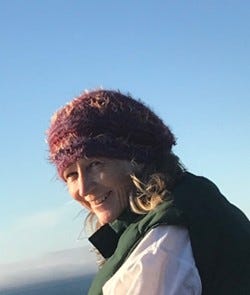
Diane Pendola has lived for fifty years in the Sierra Nevada foothills of Northern California. The wildness and beauty of this living world ground her and inform her work as a writer and poet, teacher and eco-contemplative. She has an MFA in poetry from Pacific and a degree in Theology from the Graduate Theological Union in Berkeley, California. She maintains The Skyline Writers' Sanctuary and is involved with The Lioness Tale Prison Project.
Thank you. You made the fire’s hunger real. Justin was a guardian. We live and reflect that of which we become guardians. Great story. Ripping writing.
I loved the gentle trajector of tenderness toward the trees, land, this beautiful dog, and in the end, even the bear. A difficult thing, to tell a story of loss in a way that prepares the reader to hold the grief with you - thank you for showing us how it's done.