


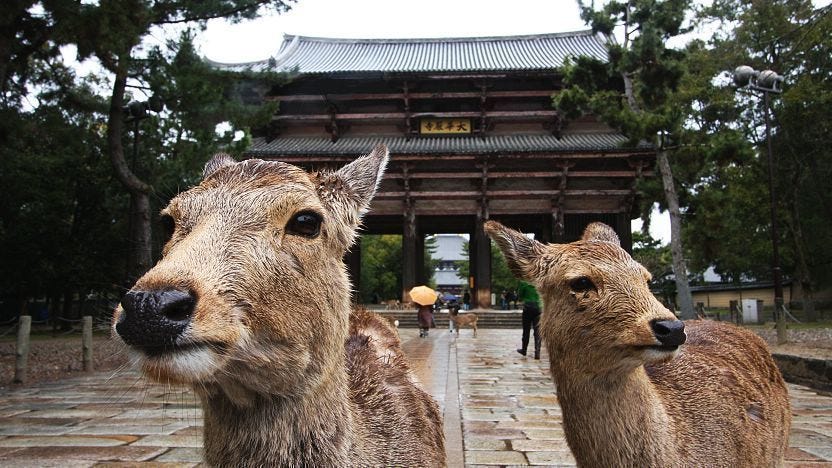
DEER LINED THE STREETS by the thousands, a cervid-filled post-apocalyptic landscape. They wandered, docile and unbothered by any tourist’s attention, eager to uncover the morsels of food hidden in pockets or handbags. With legs celery-thin and winter bodies blubbery, the Dalí-esque animals seemed unstable, like a breeze could blow them over. Kate and I left the train at Kintetsu-Nara station and followed them. It wasn’t hard: they left a pungent, organic smell behind them.
But when Kate and I looked closer, we realized the most remarkable thing about the deer was what they were missing. Every one of the thousands that lived in Nara had the points of their antlers filed to nubs, a measure taken to avoid piercing tourists. But their blunted stubs gave the deer a haunted look as they nosed through our bags as if searching for a part of themselves that had disappeared forever.
I sympathized with the deer near the station. I, too, felt filed down. And although I didn’t know it then, my own blunt conversation would occur two months later, on a cold February morning back in Chicago, when Kate and I agreed to split our assets and trim each of our separate lives down to the nub.

In December 2018, Kate and I were two days away from the end of our vacation to Japan. A month before, we’d been in Vancouver to celebrate her 35th birthday but chose to end that trip early after the severe talk where we first vocalized the word divorce over Tuna Pepperdine. Divorce is a heavy word, one that shakes the table when it lands. But our trip to Japan had already been planned and paid for, so if nothing else, we figured it would be an opportunity to do something we both loved: travel.
2018 was tumultuous, as unresolved resentment on both our parts had surfaced in unusual ways. We’d argued about a wrong turn while she was driving us to a movie four years earlier, and since then Kate had refused to get behind the wheel, and I was forced to chauffeur her to work, shopping, and meet-ups for drinks to which I wasn’t even invited. Some part of me believed this deliberate pedestrianism on her part was just a phase, and if I played along, she’d see how difficult it was on us both. I didn’t realize how enabling my acquiescence was for her and in turn how exasperated I felt with my own compliance. All my resentment simmered until, under the guise of needing some time to myself, this frustration manifested in a massive 3,000-piece jigsaw puzzle I constructed by myself in the basement. I stayed up until two in the morning every night for a month and succeeded in avoiding her. It didn’t help. I still felt used; she just felt sad and alone.
But in Nara, Japan, in the safe anonymity of a foreign country halfway around the world, we could play at normalcy: neither one of us had to drive, there were no late-night puzzles. We’d long been accustomed to one another’s rhythms. With the familiar schedules of life stripped away—up at six am, dog walks twice a day—we could fall back on being strangers in a strange land, forgetting—or ignoring—all that awaited us at home. Japan presented pretense: every experience heightened. The streets were as clean as everyone said they would be, the steamed-bun vendors as friendly as we had been promised. The trains really did run precisely to the minute; the people-pushers really did push people.
This trip to Nara occurred two days before we flew back to Chicago, and I figured the deer could capstone the trip before our impending fifteen-hour flight and return to whatever awaited us at home. I stuffed the map of Nara in my pocket while Kate, wearing a leather jacket and a light red scarf, pulled ahead of me in the crowd. She had big brown eyes—not unlike the deer—and a wide smile that showcased all her teeth. I’d always loved her exuberance when experiencing something new. She embraced the newness with her entire being.
Now, with her brown hair pulled back in a ponytail, she seemed anxious to move forward while I lingered behind, taking in the surroundings. The white peaked mountains of Kasuganocho Park rose in the distance, pointing towards Mt. Kasuga Primeval Forest, an ancient woodland so close and foreboding it seemed Macbethian. Everything in Japan seemed closer than sites at home, and traveling a mile in any direction one might stumble across a wooden, ancient temple, a futuristic glass building, and a forest that had existed for more than two thousand years. Japan reminded me that the future is built on the past—and that the past is inescapable.

As soon as we left the station, the deer mobbed the streets with the bossy attitudes of toddlers who marched in both confidence and ignorance. The air smelled stale and earthy, like wet grass or hay on a farm after a rainstorm.
In person, deer are larger than you imagine, and fluffier, too, their winter coats like floating pillows on sticks. The deer had threads of black hair interwoven in their dusty grey-umber fur, making them look dark and broody, and they all had a bright white splodge of fur covering their tail, as if they’d been marked with paint. They did not look like Bambi or Rudolph or even the deer we might see in the woods of the States. They looked both out-of-place and at home, like they belonged in the streets and we humans had intruded on their natural, concrete habitat. They wandered everywhere, like drunks at a party who insisted on not being avoided.
The day sparkled, beautiful and sunny. December in Japan feels pleasant, jacket-weather, and I wore a short-sleeve button shirt, jeans, and a hoodie. The deer loved the hoodie. They nipped at the zipper and pulled on the drawstring. To this day, one end is still missing its knot.
Kate and I had met in upstate New York when I’d been in grad school and she’d worked at a bookstore. She’d grown up the area, and I was a newbie, so she took me sightseeing around upstate. Leaf-peeping, she called it. We’d just started dating, and on the spur of the moment—I didn’t have class, she wasn’t on the schedule—we decided to go on a spontaneous trip to Vermont. We stopped in the Green Mountain range, found a funky, roadside motel with a vacancy, and hunkered down for the night. The next morning, we explored southern Vermont, trying every creamery and brewery we could find on our way home. I’m certain our love for each other was born on that trip, twelve years earlier.
The deer were not the only reason Kate and I had come to Nara. We also planned to visit Tōdai-ji Temple. We loved that fusion of novelty and history, to see in one place two things we never would find at home. Nara seemed ideal for this mix. The Shinto, Japan’s indigenous religious order, raised the deer in Nara, and legend tells that the Shinto God of Thunder, Takemikazuchi, rode into Nara on a white deer—quite a different image than the dark brown, dusty deer we saw in the city. In contrast, the Buddhists, who arrived from China in the 6th century, built the Tōdai-ji Temple, and Buddhists still travel to Nara to find satori, spiritual enlightenment—the same enlightenment the Shinto find with the deer. The Shinto and the Buddhist, the Japanese and the Chinese, have blended today, intertwined in a culture impossible to cleave.
Kate and I began our own excursion down the kilometer-long stretch of road to Tōdai-ji Temple. We could cover a kilometer in twenty minutes, but it seemed to take hours as Kate and I zigzagged from one side of the street to the other, always careful to stay within eyeline of each other but otherwise content to wander alone and without saying a word. The west side of the street housed scores of touristy restaurants and stores selling souvenirs, and they burst with visitors. The buildings, like many of the residences in Japan, had the slanted, rippled roofs that I’d expected to see; others reminded me of the brick bungalows I saw back home. To the east of us, the park expanded, the winter-dead grass empty of color. Other tourists would approach the deer that lounged on the side of the road like unhoused humans. Despite being warned approximately every seven steps by multilingual signs reading The deer of Nara Park are wild animals, everyone stopped to pet them—children, grandmothers, teens. Their fur wasn’t as soft as I’d expected; it crunched under my fingers, like hair left under a dryer for too long. They especially liked to have the spot between their one-inch antler stubs rubbed. Maybe it reminded them of what was missing.
I thought about what I was missing, too. Missing home, missing work, missing Christmas, missing my dog. Kate walked ahead of me, unaware I’d paused, and took pictures of the people and deer on the path. I knew that at some future point, back at home, I would be looking back, missing this moment, too: this feeling of escape and performance in equal measure. I paused, stuck in the beautiful pain of nostalgia, in the pause between breaths in a memory I’d only think about in retrospect.
In contrast, the street teemed with life: full of deer, full of people with the deer, full of people selling deer trinkets and deer food and tiny statues of deer. Some of the deer lounged at the base of trees, nibbled at the grassy nubs, yawned. Others swarmed the street, their hooves jackbooting on the pavement. The sound of their snorting echoed. I felt a soft tug on my behind, like being goosed or groped; startled back to reality, I turned to see a deer holding my paper map in its lips, munching like he’d just found a delicious piece of fruit.
But they also slumbered under the trees. Many nestled together in packs of five or six, curled up in what Kate described as families. She grinned when she saw them and knelt to pet them; she loved the licks she received from the herd in return. I smiled back but was drawn to a lone deer, the one keeping to herself, sound asleep, eyes closed and still. I got close and she raised one eyelid in curiosity. Deer’s eyes are deep and dark, like a clear night sky. When they look at you, you can’t help but think about the secrets you hang onto, and the ones you want to let go.
Everything on the street revolved around the deer. An old man, face creased like paper, beamed from his street cart where he sold Shika-senbei, “deer crackers,” large, round discs of baked grain, which we could buy five in a pack to break up and feed to the animals. They smelled oaty and crumbled to the touch. The signs on the street said, A polite request from the deer when feeding them: …When you don’t have any crackers left, show us by raising both hands in the air. I bought some and the vendor nodded at me, the same nods I got the entire time we were in Japan from locals who didn’t know English, like a half bow and a bob. I gave half of the stack to Kate. She wandered away, feeding some of the deer who approached her, but as I held the biscuits in my hands the deer overwhelmed me, and I imagined myself not as a tourist but as a virus, attacked by identical-looking white blood cells. I felt their lips on my hands and arms, pinching and grasping like two long fingers, as they devoured the leftover crumbs. Their large, muscular tongues seemed to pierce the air like fingers, with a plunging, probing prehensility. I threw my hands in the air, complete surrender to the deer, but they ignored me, obviously unable to read the sign and obstinate in their insistence for sustenance, and continued to maul at my body. Kate never noticed. I escaped by shooing them away with a yelp, and ran to catch up to her.
Other vendors sold people food, like fried beef or Taiyaki, sweet fish-shaped cakes. Kate and I stopped for a snack. That’s another thing we did well together—new gastronomic adventures. My pescatarianism becomes somewhat more flexible in foreign cities, but during that year Kate had abandoned her vegetarianism wholesale, a choice I’d become annoyingly sanctimonious about at home. But here in Japan, over the course of the trip, Kate and I had tried a jellied octopus on a stick, baked crab claw, Takoyaki (balls of fried octopus), multiple types of saki, monkfish, sea urchin, the best piece of sashimi I’ve ever eaten, a fried spaghetti sandwich, Fugu—the fish that poisons if prepared improperly—and multiple braised meats or veggies on sticks. Neither one of us, however, could try the roasted sparrows, which turned on small spits like pathetic, skinny bats.
Despite twelve years together, we still travelled in opposite ways. Kate sees a city through the lens of her phone, always aware that she’ll post about the trip that night or send the snapshots across the ocean to her mother. I’m impatient with both the photo-taking process and the posting after-the-fact, and my own family has chided more than once that I don’t share my snapshots. If only I had them to share. I wish I could say I’m so immersed in the beauty of the moment, but the truth is, I’m just impatient, wanting to see the next sight, wanting to visit the next place, wanting to eat the next meal. Eager to take in as much as I can. But now as I write this, I’m amazed how the very few pictures of the deer and of Nara that I do have spark such clear memories.
What would I remember if I still had all the pictures Kate took, too?

We made our way past the deer to the imposing Tōdai-ji Nandaimon Gate, a wooden structure that marked the entrance to the temple grounds. Constructed in 1199, the gate towered over us. A hundred people could fit beneath the structure, which stretched a hundred feet above our heads, under two flanged roofs stacked on top of eight immense crossbeams. Columns of wood as thick as redwood trunks dominated the gate. On both sides, two menacing 25-foot statues monitored the temple grounds, each housed in its own mammoth room. The Nio Guardians have huge, angry faces atop powerful, warped bodies lithe in contrapposto. They protect the temple from evil spirits, demons, and robbers. Like everything here, I can’t help but make meaning out of these guardians. Their names, Agyo and Ungyuo, are the first and last syllables in the Japanese language. Agyo and Ungyuo, birth and death, beginnings and endings. They look to the past and to the future, to see what has happened and what is yet to come. I recognized the look in their faces, contorted in expressions of pure animosity. They seemed fierce and angry, their bodies muscular and twisted. The closer I looked, however, the more I realized they weren’t mad at all—their twisted bodies were simply writhing in dance. They’re playing a game with us, taunting us with all the knowledge we cannot see.
A few hundred yards away, the enormous Tōdai-ji Temple rose from the dull yellow grass. A huge, gaping entrance spanned the mouth of the building, above which four rows of ornate, white and brown patterns zigzagged under a swooping roof. And crowning that roof, two bright gold towers curved inwards like horns. It was as if it were mocking the antler-less deer. I remarked to Kate that it looked like an optical illusion, like a normal-sized building much closer to us, with minuscule, fawn-like people entering yards ahead. It felt that way too, the walk up to the building taking far longer because the building imposed so much more than one might expect. I suppose the illusion is deliberate, to encourage satori as visitors walk the path. Kate chuckled then meandered down the track to photograph the surroundings. As usual, I felt impatient for the temple itself but forced myself to follow and found a small pond of koi fish nearby. I relished the quiet reflection the water offered.
I thought about the last two weeks of this trip with Kate. I felt pulled in two directions at once, looking to the past and to the future like the Nio Guardians. Everything with Kate felt so strained at home—the forced drives, the midnight jigsaws—but the trip had seemed to reconnect us. I hoped Kate and I would continue that reconciliation when we got back. Considering all the antagonism and loneliness we experienced at home, I had enjoyed pretending in Japan, and maybe we could build on that. We’d been doing it throughout this trip, first visiting the tourist-trap Robot Restaurant (a laser-light, live-action Power Rangers episode), then with two days in Tokyo Disney and Universal Studios Japan. But we’d also been learning about traditional Japanese culture: Just the day before we’d seen the thousands of bright vermillion torii gates at Fushimi Inari Temple, the ones that stretch for miles up a mountain. At the entrance to the shrine, we’d been stopped by a Japanese tourist who recognized us as foreigners. He spent half an hour practicing his English with Kate. I could tell she enjoyed this, her face erupting in wide, open-mouthed grins, telling him that “his English was amazing, far better than our Japanese,” and bowing when he thanked her repeatedly. She glowed for the rest of the day, and I was reminded of what I loved about her.
I turned away from the pond and back to the temple grounds, eager to see the two main attractions in Tōdai-ji Temple. The first, the Giant Buddha statue, greeted me when I walked in. Magnificent and towering, the Buddha is the world’s largest bronze representation of the deity Vairocana, and he draws your eyes as soon as you enter. He sat with arm outstretched; one hand upright, as if pushing against the future, and the other calmly placed in his lap. The aloft palm’s span was the size of a human. The metal glowed as if lit from within, the smooth bronze impressive at five hundred tons and fifty feet tall. Although he had been reconstructed multiple times, he still had the gravitas of ancient wisdom, like he could survive a post-apocalyptic world. His utter materiality, his presence, is ironic, though. Vairocana embodies the concept of śūnyatā, an Indian philosophical concept often translated as emptiness or the void. In all his majesty, in all his absolute being, in its desire to be something, to make its mark on the world, the Giant Buddha statue symbolizes absence and loneliness.
In contrast to the symbolism, the second attraction in the temple literalizes absence: a hole in the bottom of a wooden support column. This supporting post, about four feet in diameter, has been called “Buddha’s nostril,” for at its base the small hole is said to be the same size as one of the statue’s nose holes. Legend has it, if you can squeeze your body through the hole, to be “sneezed” out the other side, you will obtain enlightenment in your life. A line stretched ten people deep to try to fit through the hole, which was no bigger than a doggie door, and I saw a few young children and some slender people slip their way through. I knew I could never fit; Kate could have but chose not to try. It was like she was giving up.

Maybe we didn’t need the trip to understand each other. We’d been going to couple’s counseling to renew our relationship, to find ourselves again. But instead of healing, we’d discovered that our absences and loneliness were just symptoms of a disease that had been part of relationship for years, starting at the beginning when we married and moved to Chicago, away from her family and friends. Away from her home. The one trip it turns out she hadn’t wanted to take.
Even as Kate and I explored the temple together, we split apart. I wandered to the back and watched all the people streaming in. A podium of incense sticks was positioned at the front of the temple, and an aromatic breeze wafted back to me. It smelled like warm tea. I saw Kate walk up to the podium and grab a stick, light it, and plant it in the sand at the top. A thin line of smoke rose from the stick, and she followed it up until she caught my eye, staring back at her. She gave a closed half-smile and waved me over.
When I look back on that moment I knew that Kate and I had come to the end of our relationship. That smile, etched in my memory, echoed acceptance more than happiness. My memories of Japan intertwine with the two months after our return, during which we would quit couples therapy; we would fight and make up, and then fight again; we would weep and spiral and crawl away from each other; we would admit truths we had been too scared to talk about and too confident to admit to ourselves. We would storm and sit in silence. In less than a year, we’d be divorced, living in separate houses, splitting up our small family of dogs and cats by species and thinking of all the endless possibilities that were to come and those that would never be.
Kate and I stared up at Vairocana, standing together in silence as streams of tourists and pilgrims washed past us.

When we left the temple half an hour later, we found a door that led back to the main street. Wooden, like everything in Tōdai-ji Temple, this one at least was human-sized. A sign taped on the deep brown wooden slats read, in Japanese, Chinese, English, and Korean, Please close the door or the deer will come in. For that hour in the temple, I’d almost forgotten about the deer that roamed outside the gates.
I thought of the people that traveled to Nara. How many of these people fell back on familiar roles in this unfamiliar space? When we travel, we play at being, whether we’re trying to fit into a culture to which we don’t belong or enjoying the kitschiness of a manufactured experience. In some way, all travel is a masterclass in acting: acting like you belong, like you are different from every other traveler out there, like you can blend in, like you can play the part you’re supposed to play and live the life that’s been prescribed to you.
Is marriage the same thing? I didn’t think so at the time, but Kate and I had long been stuck in a performance of marriage. Our everyday interaction had become a recital which recalled a past when we’d first gotten together rather than the future we were working towards. Being in Japan on our last trip as a couple allowed us to play, to act: to perform the roles we had cast ourselves in over a decade before. We recited by rote the same interactions, the same scripted anecdotes at parties, the same stories we told ourselves when we convinced ourselves counseling was working. Maybe we travelled for this reason: to make obvious the one type of performance in order to hide the other, the one we didn’t want to admit to ourselves.
Maybe we went to Tōdai-ji Temple, to the Giant Buddha Hall, to Vairocana for this reason: to discover the absence at the heart of our lives. But still my strongest memories of Nara are those deer, their antler stubs always reminding me of the parts they were missing, and of the part of me that I’d miss when I returned home.
Walking to the train to take us back to Kyoto, Kate ahead of me and hundreds more tourists pouring down the street towards the temple behind us, I looked at the deer crowding the streets. Their home would always be this manufactured life in the park. Neither pets nor wild animals, they exist in between, their antlers stubbed in the name of their conformity and our safety. The deer’s pretense has become their reality.
On that train back to Kyoto, on the plane back to Chicago, and for the next two months, Kate and I would also pretend. But at some point, we had to make the decision to stop pretending, and find our own separate way back to a reality neither of us wanted to face, to an absence that was there the whole time.
About the author:

Paul Booth is an author and academic living near Chicago. He holds an MFA from DePaul University and a PhD from Rensselaer Polytechnic Institute. His work has been published by Doctor Who’s Big Finish Productions, The Worlds Within, Freedom Fiction, Killer Nashville, Uncanny, Stygian Lepus, InMediaRes, Outside In, Antenna, and more. He has also written or edited more than 15 academic books on topics as diverse as fandom, Doctor Who, digital media, time travel, and board games. He is currently enjoying a cup of coffee.
Sometimes you come across sentences you believe have never been said before. Whether actually the case or not, they give you confidence that the writer's paying attention, both as observer and as sentence-maker. That's how I felt about: "I, too, felt filed down." So simple, yet a perfect example of paring a line down to its most basic form; it's also a great example of letting a physical image represent an impalpable inner state. It feels unforced, arising naturally from the moment.