


I WAS DRIVING HOME from work and Mom called to give me the plan for my overnight visit—for the fifth time. She was eighty-five and repeating herself more regularly. The intense Dallas sun fried my left side, and the sound of her voice added to my discomfort.
“We’ll have dinner at La Mariposa, then we’ll come back to the house and you’ll sit in my pink chair and visit with your father.”
This time, after hearing the instructions, I snapped, “I’ve got it Mom. I’ll talk to Dad!” I took a deep breath, adjusted the air conditioning vent, and quickly added in a cheerful, high-pitched voice, “Can’t wait to see you, Momma!” My father always wanted more conversations. He wanted me and my two older sisters to hear details of his early life and his bank accounts. He was aware of death looming and felt an urgency to relay important information. He also liked to hold court, and we were all well-schooled in being his admirers. I assumed this time he needed my undivided attention, and Mom was making sure I provided it.
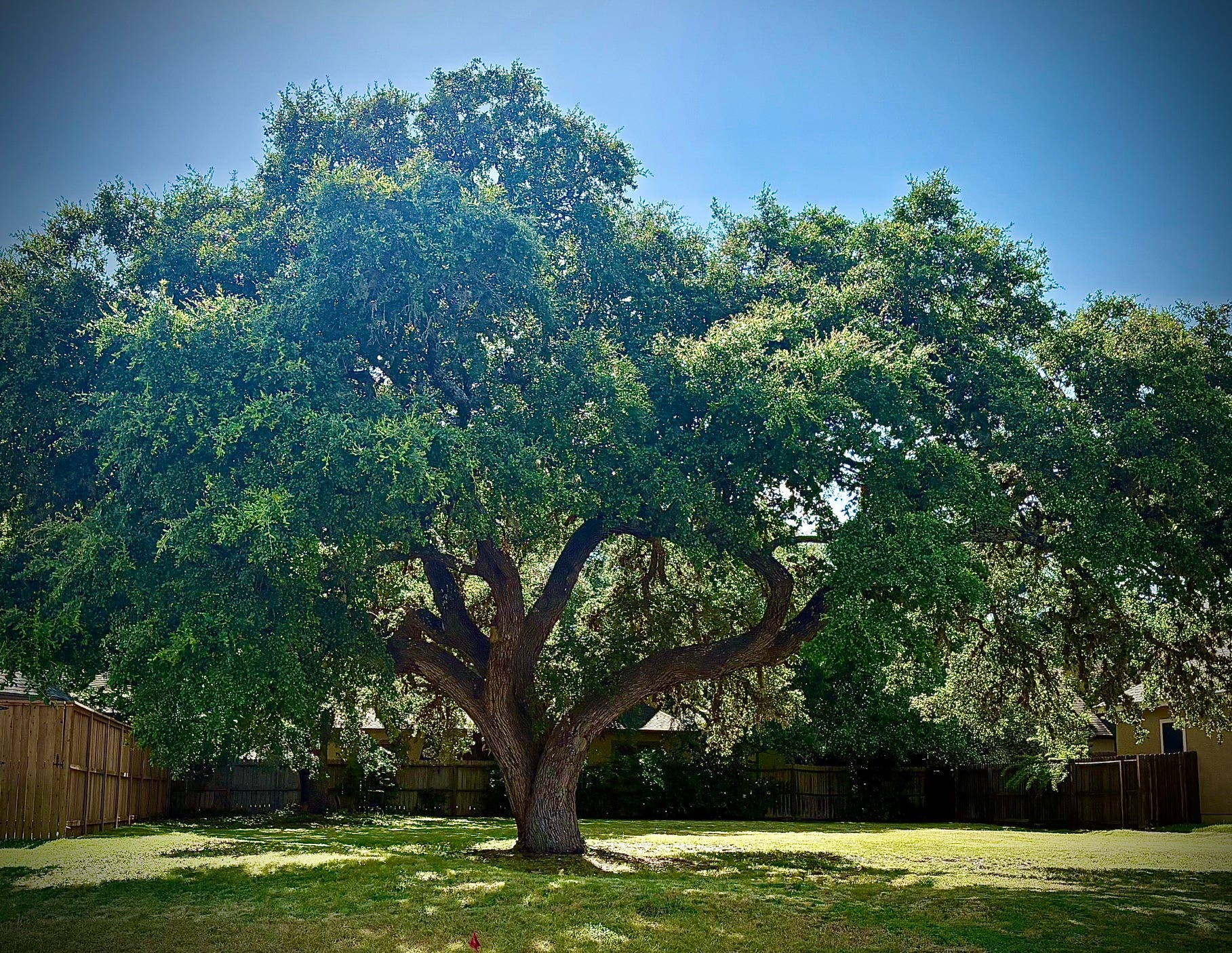
The next afternoon, I took the fifty-minute Southwest Airlines flight from Dallas to San Antonio, rented a car, and drove to their cottage in a retirement community. Live oak trees lined the street to their home, reminding me of childhood days spent climbing their low, sprawling branches. As always, my parents greeted me with hugs and warm welcomes. Although it was just four in the afternoon, Mom and Dad were already dressed for dinner, muttering about beating the crowds. They located car keys and turned off lights while I put my bag in the guestroom and quickly brushed my hair. We piled in their Lincoln Town Car, which drove like a pontoon boat, and headed ten minutes away to La Mariposa for Tex-Mex. I captained the vessel with Dad riding shotgun and Mom suggesting better routes from the backseat. During dinner Mom and Dad were distracted and quieter than usual, making me wonder if they were angry with one another. I filled the void with cheerful chatter fueled by a slushy margarita. They both looked past me during conversational lulls and, despite my best attempts at humor, their chuckles felt forced.
As soon as we returned to the house, Mom reminded me to sit in “the pink chair,” her swivel chair next to my father’s La-Z Boy. I took a deep breath and reminded myself I would be leaving the next day, so I could be more patient and give my father the attention he needed. Dad plopped in his brown leather recliner, and I sat in Mom’s mauve velvet swivel. I heard Mom in the next room gathering magazines, and soon, she swished behind us to the dining table where she sat within earshot and flipped busily through her collection of retail mailers.
I should have sensed the set up, but I was oblivious, having assumed this was about Dad, the usual drill. What my father said next in his deep baritone voice drew blood to my face.
“I want to talk with you about your relationship,” he said. He leaned back in his chair, folded his hands in his lap and twiddled his thumbs. Then he looked at me with unblinking eyes, reminding me of times I was in trouble as a mischievous ten-year-old. Back then, his words were punctuated by puffs of a pipe, filling the air between us with Sir Walter Raleigh tobacco smoke. Now the air between us was clear, but it was no easier to breathe.
Four years ago, when I fell in love with Jill and then began living with her, I told everyone about our relationship. I reflexively told acquaintances at the grocery store, systematically told friends and family members, and even told the leaders of my church. I just wanted the telling to be over so I could move on, with or without those I told. But I did not tell my parents. They knew Jill, had visited our home, and seemed comfortable with me introducing her as “my friend”. They accepted vague references to bedroom arrangements without me having to blatantly lie. I rationalized it this way—Mom and Dad are eighty-five and live five hours away. They probably don’t want to know. It’s too much for them. The divorce from David after a twenty-five-year marriage was enough—now this? They might feel ashamed of me and not want to talk about it amongst their conservative friends. Maybe a “Don’t Ask, Don’t Tell” policy will spare them despair and embarrassment in their community. The truth, however, was that I didn’t tell them because I couldn’t bear their disappointment in me. While I could deal with the rejection of others, I could not bear their potential rejection. I had spent a lifetime seeking the glow of their affirmation; rejection was incomprehensible and terrifying.
Looking back, my ruse was ridiculously implausible. The house Jill and I shared was a 1400-square-foot cottage built by someone’s drunk uncle in 1950. No corner was ninety degrees and dropped pencils rolled five feet before stopping. On a whim, I stenciled, “Nothing in this house is straight” in muted colors high on a hallway wall. Light switches were randomly placed, requiring six attempts to turn off a hallway fixture. We had to treat plumbing cautiously, only running one thing at a time (e.g., “Don’t start the dishwasher yet, I need to shower”). But I loved the coziness of the wooden floors, the soft light, the relatively large kitchen, and the proximity to White Rock Lake Park. Jill and I moved through the tiny cottage in sync with shared dogs afoot and cooking duties coordinated. “Where did you put the capers?” “Lower shelf next to the leftover pasta from Tuesday.” Or, “Are we out of paper towels?” “No, we have a few more left from the run to Costco—back shelf in the laundry room.” Anyone observing us in that house would sense the intimacy of our relationship. But still, I found it easier to act as if the elephant in the living room was just a pet schnauzer.
Jill was more than fine with my stay silent strategy. When we fell in love, she developed a stammer. “D-d-d-d-do you w-w-w-wanna meet for a beer?” When I looked at her with concern, she looked at her feet. “Jill, is that a stammer?” “D-d-d-don’t laugh at me!” She opted to let her loved ones find out about our relationship by observation. To my knowledge, she told no one that we were romantically involved. While my guilt made me reflexively tell everyone, Jill’s guilt silenced her. She often joked, “You’re outing me to EVERYONE!” Well, everyone but my parents.
My father was a Baptist preacher through my early years before he earned a doctorate in psychology. He spent the rest of his career as the director of a nonprofit agency melding ecumenical faith with medicine. He evolved from a small-town conservative Baptist preacher to a big city progressive Baptist preacher to a psychologist dealing with all different kinds of people. He was a smart man who was not afraid to grow and change. His views on homosexuality were progressive for a religious man of his generation, but his openness had not been tested by having an immediate family member announce their queerness to the world.
My mother worshipped my father. She too, was Baptist and in many ways had a more childlike faith and more conservative views than my father. She saw my dad as the authority on life. It is no wonder that she set him up for this tough conversation with me. I imagined the many heart-wrenching exchanges they had leading to this moment. I am guessing they plotted and planned the exact language that would be used and the tone offered. I now understood why I was sitting in the pink chair, and Mom was thumbing mindlessly through magazines, just within earshot.
I looked at my hands, then back to my father, wondering what he had to say about “my relationship.” I braced myself for his disappointment, ready to accept the fact that I was an embarrassment to him. My body sat heavily, knowing I didn’t belong there—the daughter who never liked pink trying to be comfortable in her mother’s chair.
My father held his soft, preacher hands with fingers interlaced at chest level, elbows resting on the chair arms. His blue eyes pierced me as he said in his low, strong voice, “I don’t understand it, and I’m not going to analyze it. I do wonder…” Then he shook his head gently, blinking as he continued, “Nope, no, I’m not going to analyze it.” He unlaced his hands, slowly double chopping with the words, “I just want you to know she will be a part of our family.”
He lowered his hands, took a breath and added, “I see how you’ve done this. I appreciate that you aren’t flying a rainbow flag and shouting from the rooftops” (i.e., thank you for not embarrassing me in my San Antonio community). I couldn’t blame him for this observation; many in his generation still carry deeply entrenched judgement about alternative lifestyles. And, gosh, he grew up in a family that thought card games and dancing were sins!
He looked in my eyes with such tenderness, I was overwhelmed. He clearly wanted to understand more, but mostly just wanted to be fully included in my life. And he still loved me. My body felt like a melting candle. The pink chair felt soft again.
After I found my voice, I said, “This, Daddy. This is why I’m a whole person. This is why I have been able to mend my life back together after breaking it apart. This is why I can still love myself. This grace that you are giving me and have given me my whole life has made all the difference.”
Then I cracked a joke because that’s what we do in our family when we are overcome with emotion and need to switch gears. “Why do I feel like I’m a ten-year-old who’s been called to your scary study for a punishment and instead gotten a promise for a Disney World trip?”
At this, Mom laughed heartily from her perch, and I remembered she was the mastermind behind this conversation.
I told them both, “I love her and I am happy.”
“We see that,” he said.
Momma nodded her head from the back row, now ready to be part of the conversation.

My parents raised me with love and long reins. Being eight years younger than my older sisters, I had many nights alone eating pizza in front of a TV. They missed some high school performances and didn’t notice the rules I broke. It is not surprising that I thought I could sneak “my relationship” past them, given some of the egregious behavior they ignored during my adolescence. But they were not going to ignore this one. They were not going to be feeble-minded parents pretending I was living with a friend, while the rest of the family knew I was in love with that friend.
My parents were courageous and generous. They named the elephant in the room when I couldn’t. They didn’t ask me to explain my relationship, nor did they scold me for my lie of omission. They simply loved me and then promised to love Jill.
When I said goodbye the next morning, there was relief in the air between us. I hadn’t fully understood how much tension the lie held until the lie was gone. The lie took so much energy that being with them was exhausting, often making me ready to part ways. I made visits brief, ready to get back to my real life in Dallas. But now that there was truth, I wanted more time. We held each other tight, looking into each other’s eyes and saying our “I love you’s”. As I climbed into the rental car, they stood in the doorway waving, looking taller than I remembered. Tears rolled into my smile as I backed out of the driveway, waving one more time before slowly driving away from their brick house canopied by live oak branches.
They moved to a retirement community in Dallas a year later, and I was thrilled to have them closer. As they promised, they fully accepted Jill as part of the family. My mother passed Jill in the hallway of our home and gently cupped her wrinkled hand around Jill’s cheek. My father crinkled his eyes and held her hands close when he greeted her.
Hard truths are painful, but without honesty, relationships are like a tree that dies from the inside out. Left standing is a brittle skeleton that some may call a tree, but is in fact hollow and dead, cracking at the first gust of wind. I am lucky that my parents valued truth and their child more than societal norms. Their courage enabled our family to grow like those San Antonio live oaks, full of twisted branches but capable of flexing in strong winds.
They were both gone three years later. They left me with the assurance of their love while fully acknowledging my love for Jill. They gave me the gift of truth before I could regret not sharing it.
About the author:
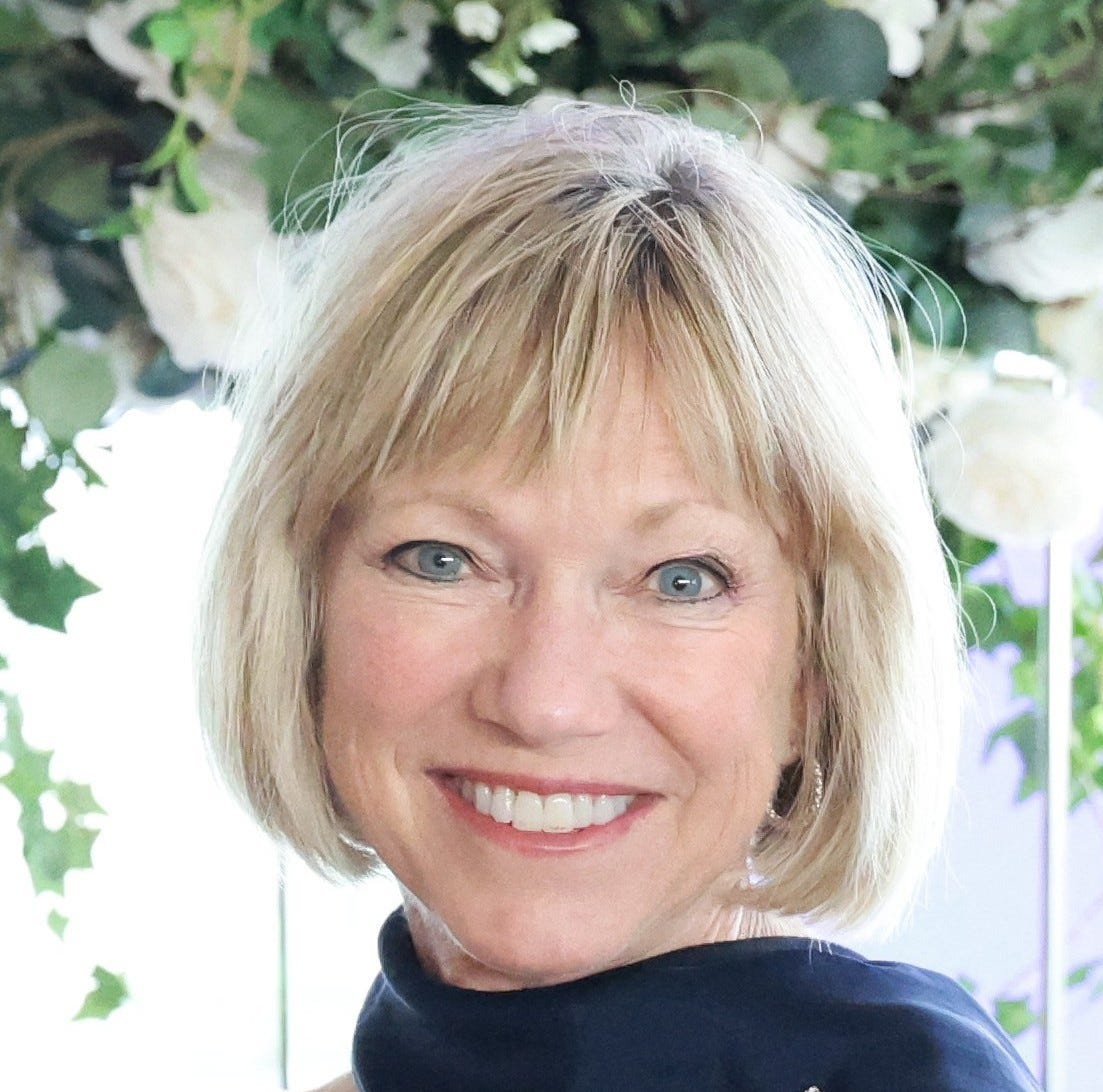
MerriLee Anderson is a clinical psychologist and writer. She is working on a memoir exploring her life’s pivot from a 25-year heterosexual marriage to embracing identity as a late-in-life lesbian with two lesbian daughters. Her essays have appeared in Rathalla Review, HerStry, You Might Need to Hear This, biostories, and Gathered Words Anthology. She was recently awarded Honorable Mention in the Humor category of the 94th Annual Writer’s Digest Writing Competition. She lives in Dallas with her wife, Jill, and mutts, Rosie and Daisy. She loves full moons, hand-shaken margaritas, and adventures.
The artwork for this piece is courtesy of MerriLee Anderson.
My heart is full after reading this! I loved your parents, and I especially love you, ML!!!
Tears rolled into my smile..,
I love that line.