


NOBODY BELIEVED ME when I told them demons sat next to us in the classroom or watched us pump back and forth on swings with chains that were probably illegally long. And when I described these invisible demons in intricate detail, people either made fun of me or scrunched up their faces and side-eyed me—the same way I do now when my QAnon sister tells me “demonocrats” inject the blood of children to stay young. And, like my sister, I actually believed, wholeheartedly, that what I saw was real.
One day in fourth grade, while I stood in the lunch line at school waiting for my cheese zombie and applesauce, I imagined one of these netherworldlings staring at me, as hungry for my soul as I was for my cheese zombie. The demons were short and round, with werewolf-like fur and yellow eyes. They had feet and hands like chimpanzees and square teeth with gaps between them. I knew this because my dad told me so. He dreamed of Satan and the final battle, and claimed that within those dreams, he could see demons standing beside us at school.
I was already a high-strung kid who pulled out my eyebrows and imagined thieves lurking outside my window at night as I lay sweating, heart pounding in my bed. I chewed the skin off the bottoms of my feet until they became infected. My dreams were so intense, so vivid, that I repeatedly wet the bed, believing I was using a toilet conveniently located somewhere in my dream. I’d pull my pants down, pee, wipe, not wash my hands, pull my pants back up again, and then return to my dream world.
My mom told us the Antichrist was living somewhere on Earth. He was akin to the Big Bad Wolf, only when he kills you, you die and it’s over. The Antichrist takes your soul for an eternity and apparently bats it around like a cat does a mouse.
Before I turned ten, I learned that the Antichrist could’ve been anyone—the nurse, your best friend, the grocery store clerk. But sometime around 1984, the Antichrist became anyone with the potential to become a Democratic president. This was more comforting and seemed easy enough to stay away from the White House since I was all the way in Spokane, Washington.
At one point, the Antichrist was Procter & Gamble. Sometime in the ‘80s, a rumor started that the hundred-year-old logo of Procter & Gamble was some kind of code telling other Satanists or Antichrist enthusiasts that they were on Team Lucifer—even making the claim that the swirls in the man in the logo’s beard were the numbers 666. The rumor grew branches, and people started to say that a percentage of the money P&G made went to the Devil in the form of a tithe. Eventually, the company removed this logo from their products in a rebrand, even though they proved the rumors to be false by getting the more prominent and respectable Christians to vouch for them. Maybe it was too difficult to find bank statements or checks cashed in hell.
One day, after a heated and terrifying church group meeting where all of the adults collectively panicked about that week’s end of the world, we sped home in our dark-blue 1976 Chevy Nova. My parents told us we’d have to throw away all of Satan’s products. We were so poor and had so little that I couldn’t imagine what we could possibly afford to lose. Also, how did Satan manage to get products into the grocery stores all the way from hell?
“Can I keep the art set Grandpa bought me for Christmas?” I asked.
“Sure, sure—I mean, well, ask your mom.” My dad failed to reassure me. Everything had to go through her, so by the second “sure” I remembered his meager status.
“Stephen will have to use cloth diapers now,” my mom said, indicating how much more work it’d be to change my little brother’s diapers.
When we got home, my mom started singing in tongues which formed an indiscernible God-shaped sing-song tornado through the house while she hunted for signs of the devil. My dad frantically pulled out a roll of Glad garbage bags from under the sink and ignored the two dirty dishes I hadn’t had time to wash before church—something I was sure I’d get chewed out for. At least the devil spared me that. Always hip to the possibility of a joke, I wondered what my parents would’ve done if the garbage bags had also been part of P&G.
The Cheer laundry detergent was the first to go. The little circular half-moon and stars P&G logo was big enough to see from afar—making it an easy visual target. I was thrilled to see that go as the aggressive chemical smell only encouraged me to wear my clothes until they smelled feral. Then went the Bounty paper towels. Soon, it seemed like every adult staple in the house was stuffed into a giant black garbage sack of useful damnables.
Speaking-in-tongues—or glossolalia, as the educated heathens call it—was my first exposure to anything that resembled another language. Looking back, it sounded less like a language and more like logorrhea, the gibberish of an Alzheimer’s patient. But when my mom did it, she was happy. She wasn’t depressed; she wasn’t yelling at my dad. She even opened the curtains and “put her face on,” as she used to say.
The house felt lighter.
“Here—look at this.” My mom stopped God-warbling long enough to show me the small P&G symbol on the back of a tube of Crest toothpaste. “This is the Mark of the Beast.”
This was a reference to the Book of Revelation, where all end of the world info is stored for interpretation.
“A beast, like the guy in Teen Wolf?!”
Invisible demons I could handle, but an actual beast—one we could apparently see—sent me over the edge. Even school demons seemed cute, like Ewoks. But a beast had me pulling out my eyebrows.
The little symbol looked no different from what was on quarters and dimes. I wondered if they’d soon think money was evil, too—but they were too busy throwing out soap to notice that the lack of it was an actual earthly problem.
“The Antichrist. Satan’s puppet on Earth. If Jesus isn’t in your heart, then we all—everyone with Jesus in their hearts—will go up to heaven. But you, those without Jesus in their hearts, will stay on Earth for many years with the Antichrist. Chaos on Earth and gnashing of teeth,” she said.
I didn’t know what gnashing was exactly, but I did know the feeling of teeth rotting. Since my parents believed the end of the world was imminent on a regular basis, they let my baby teeth blacken out of my head—weeks of barely eating, throbbing pain, and digging out chunks of dead teeth.
“Is it just one beast? Where is it? And is it the same as the Antichrist?”
“They’re the same—the leader of Satan’s army.”
My mom only confused me more. We learned long ago that “we” is plural and “I” is singular. Just like after I started my period, I stopped asking her questions for which she had no answers, drew my own conclusions, and learned how to plug my own holes.
I started to read the Bible like it was a survival manual. I joined every kids’ club at church I could find and won every award possible for memorizing Bible verses. I learned early that rote memory could spare me both the fiery abyss and hell on Earth. I memorized the shortest verses I could find right before the contests, then almost violently shot my hand in the air to go first, before I forgot them. The more felt patches I won, the safer I felt from this gnashing of teeth and the Antichrist.
Prayer became a matter of practice, but it felt more like a constant, one-sided conversation—like I was talking to myself. God never replied, never sent any message. No bird landed on my shoulder. No voices, no burning bushes, no indication that I was anywhere on his radar.
All I had were the occasional dreams of demons walking around at school, where life on Earth was on fire and people had no teeth, or that I was tattooed with the mark of the beast—like it was a barcode to be scanned at the precipice of heaven and hell.
No wonder Jesus wasn’t talking back. Maybe I was on Team Satan and didn’t even know it.
If I feed my baby brother, change his diapers, and stop asking for a new bike, will you let me go to heaven? If I cry now, about my grandmother dying, will that help?
My grandmother had recently died, but I didn’t know her, so I didn’t cry. There were three of us kids at that point; she lived in Seattle, and none of us were old enough to remember her. When her things arrived—boxes of books, wool blankets, and hats that smelled like what I imagined women in old photographs smelled like—my dad lost the fight to hold back tears. It was the first time I saw him cry. I tried to force myself to join him in solidarity, even spitting in my hand and rubbing it on my eyes to make them look wet—but I couldn’t find one tear’s worth of sadness. Maybe Jesus knew this and thought it was a flaw in my soul.
I made sure to include talking to Jesus in everything I did. The only way to escape soul-and-body damnation was to cover all bases. But even then, it wasn’t enough—at least according to my mom.
“There’s just no way of knowing. It’s between you and God. It’s very personal,” my mom would say, tightening the knots that already gnawed away at my chest and gut.
I tried to sing, to glossolalize, stretching my tongue and lips and throat into new vowels and casting them to the heavens. But it felt weird—inorganic—like crying for my dead grandmother. I asked my mom if she could teach me how to do it.
“Oh no, absolutely not. Everyone has their own language with God. He can’t hear you if you use my language. Be patient, it’ll come,” she said, in her smug so-close-to-God voice.
But being patient, in a world of teeth-gnashing and chaos and eternal fire and homelessness and being orphaned, which could happen at any time, wasn’t helping my anxiety. I chewed my fingernails until they were no longer even considered nails, and I gnawed the skin off the bottom of my big toe until it was hard to walk—my go-to response to anxiety in those days.
I developed a new plan. If I went to school and told all the kids about Jesus, like some kind of recruiting agent, maybe God would finally talk to me.
The next morning, I went to school in my Awana outfit (Approved Workmen Are Not Ashamed, some verse in Timothy)—a yellow dress that fell barely above the knees, with a green cotton sash that had all the awards I’d won for memorizing Bible verses ironed onto it. While I was waiting for the bus, I prayed:
Jesus, I don’t know how to talk to you yet, but I’m trying. And I don’t want my teeth to gnash—partly because they already hurt, and partly because I don’t want to be in Hell. I also don’t want to not have parents—or at least not a dad, anyway. I just want to be in the spelling bee and climb the magnolia tree out front. So please make the kids at school listen to me. Please. And if you’re not going to come back, will you tell my mom? Because maybe then she’ll take me to the dentist. But if it’s too much to ask now, before we really know each other, that’s okay. I just don’t want to be on fire. Thanks, God.
The school bus driver pulled up to the stop, opened the door, and welcomed me aboard.
“Good morning, Miss K. You’re looking very accomplished today!”
Her observance of my efforts gave me confidence. She was probably the same age as my mom, but she was always smiling. She wasn’t beautiful like my mom, but it was better that way. My mom wouldn’t open the curtains, answer the door, or talk to anyone unless she went full Kabuki. And she acted differently, too, when she had her “face on”—nicer, faker. Not the woman we spent eighty percent of our lives with—the one who sat in the dark complaining about other women, screaming at and belittling my dad, threatening suicide, writing journal entries to Jesus asking Him to give her someone like Kenny G for a husband, and telling him she felt like he was her pimp—whatever that was.
“Thanks, Miss M.”
I walked toward the back of the bus to focus. On the way, someone threw an empty juice box at me, followed by laughter. My confidence plummeted—almost like coming down off hard drugs, but for kids. My ears grew hot, then my face. Surely bright red by this point, I sat down in the last seat, next to Chen, who was by the window. Chen was the only Chinese girl in my school—maybe in the entire city, as far as I knew—and my only real competition for handwriting contests and the spelling bee. Between the two of us, we always took first and second place.
Please, God... Jesus, give me strength.
Asking God for strength seemed to work, because when the adults at church went into special prayer groups, it was the most common request—or demand. It was a letdown to realize that becoming an adult, with its access to cars, sex, and R-rated movies, still came with problems.
Give me strength to save the other kids from demons, teeth-gnashing, and the Antichrist.
My face felt less hot, and my ears less purple, so maybe Jesus was finally doing me a solid. Chen held a steady gaze out the window, her hands folded squarely in her lap over a bundle of books. She smelled like foods I’d never smelled before. Most of the foods I knew were from 7-Eleven, where my dad worked nights.
“Hi, Chen.”
“Hi.” She looked at me quickly, then straight back out the window.
“Have you heard of Jesus?”
“Yes. My family goes to church on Wednesday and Friday nights, and Sunday mornings,” she replied, as if I’d asked her what two plus two was.
On one hand, this was great news: Chen and her family were saved from the Antichrist. But I couldn’t recruit her. Still, she might have some insight into other matters.
“Do you speak in tongues? Does Jesus talk to you?”
Chen’s face aged a hundred years in confusion.
“I don’t know what that is, but we study the Bible a lot. Just like homework. We take tests.”
“Oh, so maybe if you get A’s on all the tests, that means you know exactly what to do? But then does He talk to you—like He’s in your heart?”
Chen’s face relaxed a little, but she still looked at me like I was a soul barely worth saving.
“You smell like cigarettes. Do your parents smoke?”
“Yeah. They both really like cigarettes.”
They more than liked cigarettes—they smoked them all day long. The first thing both of them did each morning was light up: my dad with a cup of coffee on the front porch, and my mom hidden away in her bedroom amidst fantasies of a better life and maybe a magic mirror, telling her how beautiful she was. They didn’t always smoke in the house—just when it was cold, rainy, too hot, or too windy. Or when my mom wasn’t wearing full makeup.
“Then it doesn’t matter—they can’t achieve salvation no matter what they do.”
A new anxiety glued itself to the old ones. Maybe my parents didn’t realize cigarettes were also the Antichrist. Maybe I could be the one to save them. Maybe then Jesus would talk to me, and I could sing to Him in my own private language. But most importantly, I wouldn’t have to gnash my teeth or hide from the Antichrist—or the beast—until I died, only to go straight to hell: never dead, and forever fucked with.
When I entered the classroom, the group of cool girls stared at me. They wore the best clothes, had real Keds and the biggest sticker collections. They even had the pens with feathered, googly-eyed erasers that were kept inside pop-culture-ed-out containers at the upper right-hand corner of each of their desks. I sat down at my plain, bedazzled-with-nothing desk, which smelled like a janitor had recently been there, and tuned out.
Dear God, I don’t think my parents know that cigarettes are a deal breaker, or another kind of Antichrist. So please give me the strength to tell them, because I know they love those things almost more than anything else. Maybe even me.
I pulled A Wrinkle in Time from my desk and started to read before class began. We were reading the book as a class, but I was a chapter behind. I didn’t like bringing books home, because my parents would inevitably say they were evil and call the school. I wondered if the Black Thing was also the Antichrist. But in the book, Mrs. Whatsit, Mrs. Which, and Mrs. Who came to help the special kids defeat the Black Thing in order to save the universe. Nobody was helping me, that’s for sure. And it didn’t seem like anyone else outside of the church or my parents’ friend group was too concerned that our very existence was in peril.
Propelled by a subconscious desperation bomb, I walked to my fourth grade teacher’s desk. She was frantically making red, black, and green marks all over our papers. The lenses of her glasses were so thick that when she looked at you, her eyes seemed double-sized, like Velma’s in Scooby-Doo.
“Miss Reeves ...?”
She pushed the thick frames down the bridge of her nose and, thankfully, looked at me with normal-sized eyes.
“Go on,” she urged.
“So, is the Dark Thing like the Antichrist? And if my parents smoke cigarettes, are they going to hell? And if I get the other kids to accept Jesus into their hearts, do you think He’ll speak in tongues with me—so I don’t have to go to hell and have gnashing of teeth?”
Miss Reeves blinked a series of hard blinks that resembled Morse code and looked at me like I was a challenging math equation.
“I’m sorry, but I don’t understand. The Antichrist?”
“Yeah, and did you know there are demons with yellow eyes in your classroom that work for the Antichrist?”
I let it all out—all of my unanswered questions—hoping Miss Reeves was like Mrs. Whatsit. But she wasn’t. The look on her face became more distorted, and this time even a little agitated.
“Okay, I have fourteen more papers to mark before everyone arrives, and from the looks of it, you have some more pages to read before the quiz. All I can tell you is that there are no demons in this school. I have no idea what an Antichrist is. And if your parents want to smoke cigarettes, that’s up to them.”
She pushed her glasses back up the bridge of her nose, shook her head the way I did when our dog peed on the floor, and mumbled something under her breath that I couldn’t make out, which was probably for the best.
I wished I was wearing normal clothes, or had the foresight to bring a different outfit. And I wished even more that someone—anyone—had answers.
That night, after dinner, I sat on the couch while my dad smoked and yelled at the TV before his shift at 7-Eleven. The haze of cigarette smoke hotboxed the room, clinging to my clothes and furniture. I took a deep breath, inhaling the smoke and preparing to tell him what I’d learned from Chen. I looked at my dad’s face—tired, lined, and glued to the glow of The 700 Club. He looked like someone who needed to sleep, needed to play—needed a new wife.
“Dad, do you think you can go to heaven if you smoke?”
“Yeah, sure. God forgives sins.” He took another deep drag, held it in his lungs for a thoughtful second, and blew it out into the room like it was an exercise in Pilates breathing. I watched as the smoke mimicked the colors of whatever was on the TV.
“So then, if I can’t talk to Jesus like Mom does, do you think I can go to heaven?”
He rolled his eyes and smashed the cigarette butt into a heavy glass ashtray like it was something he hated.
“Look, that’s your mom’s thing. You don’t have to do that. Just don’t vote for Democrats when you grow up—keep listening to Pat Robertson. The guy’s a genius.”
Pat Robertson was my dad’s version of speaking in tongues. I didn’t know what he was talking about, but I knew his voice. And I knew he hated whatever Democrats were.
“Does Pat Robertson know how to kill the demons and the Antichrist?”
My dad tapped another Winston from the pack and lit it up.
“There’s no way to do that here on Earth. Just don’t ever, ever vote for Democrats,” he said, a gulp of smoke caught in his lungs.
I felt an urge to hug my dad, but that’s just not how our family was. No one said I love you. No one hugged anyone. And for the most part, that was okay with me—the farther away from my mother, the better. The thought that I had to live inside her once, that I depended on her for nine whole months, made my skin crawl. I wanted to strip out my DNA, bleach the her parts clean, and put myself back together without any of her sequencing left behind.
Before I fell asleep, I thought for a long time. Maybe because I didn’t know what a Democrat was, or the Antichrist, or God, or Jesus—or my dead grandmother—for that matter, I couldn’t possibly talk to them, cry for them, or recruit new souls for them. All I knew was the joy of a clean room, mornings, magnolia trees, bike rides, and finding new worlds beneath rocks. But their demons were real to me.
The next day, I woke up just before sunrise. The patches of snow from winter were completely melted, and the air smelled like new pine. Waxy little fists started to emerge on the branches of trees, and crows carried sticks big enough to see from the ground to their nests. No soulless American church filled with people more concerned about the afterlife than this one could compare to these mornings.
I swapped my hand-me-down PJs for fake Keds and shorts and then brushed my teeth with hot water and vinegar. After eating a slice of bread with Jesus-approved peanut butter, I slipped out the back door and pulled my barely coherent Huffy from its dark sleeping place in the shed and went out the gate. In the only gear that worked, I pedaled hard into the morning, looking for a big dentist in the sky.
About the author:

Kevilina Burbank is an American writer living in southern France with her partner and three cats. Chess, books, and writing have always been her stable lovers. This summer, she’ll be attending Oxford University’s Advanced Summer Writing Program. This is her first publication.
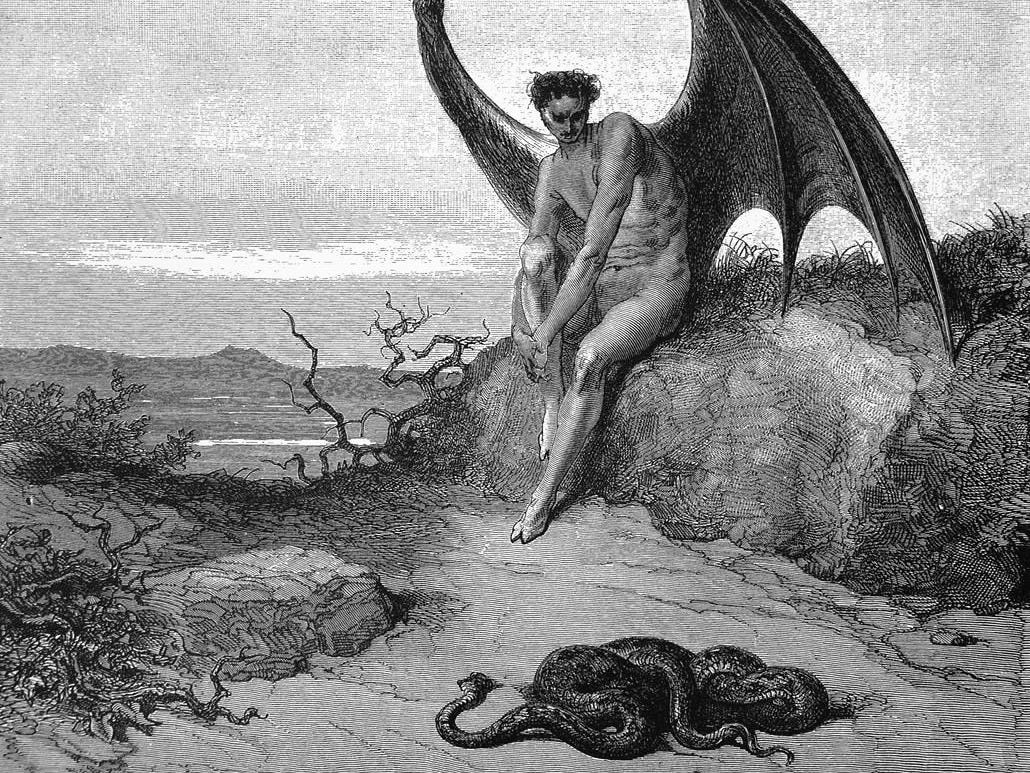
The artwork for this piece is by Gustave Doré.
This ending is so perfect. Pedaling off to go find a benevolent dentist in the sky 🚲
I identify with so many things, specific and aural. And I remain grateful for my religious relatives who did loving things for us after my mother married a non-Amish man. We try so hard for rightness and righteousness. And I wished for dentists too. This piece is spot on for describing the anxiety-inducing innocence we strivers experience and intensify to show G-d how good we are. I thank our society for public school.
Great article. Thanks.