


ON MY LAST DAY IN PARIS, I receive a text from a longtime friend and coworker back home in Minneapolis: Secret police are executing us in the streets, in broad daylight. Another friend and her spouse had recorded a video, which was attached, of the scene in the street in front of their house where a woman had just been shot in the head. Our friends were okay but shit was blowing up on Portland Avenue in South Minneapolis. The woman was Renee Good, a thirty-seven-year-old mother and wife—and, like me, a poet—executed on film by ICE agent Jonathan Ross, who was whisked away from the scene and moved by Greg Bovino and his Reich-cosplay greatcoat out of state, where he remains free and yet to be charged.
I am standing in the Place de la Concorde, where the world’s most famous guillotine lopped off the heads of King Louis and Queen Marie to cheering crowds. I can see sniper holes in the shutters of a corner room in the Hotel de la Marine, through which Nazis who had occupied the hotel shot resisters as they rose up in anticipation of the arrival of liberating forces of the US Army's 2nd Armored Division. Around the corner are plaques along a wall of the Tuileries commemorating students—the FFI—regular people who died in those final days of the occupation.
Between the sniper holes in the shutters and the plaques to the Resistance’s dead are marks in the stone walls of the Hotel de la Marine. The dozen and half marks are not the result of wear and tear on an aging facade. They are a preservation of the literal crossfire, where bullets hit and ricocheted.
I need to get home.

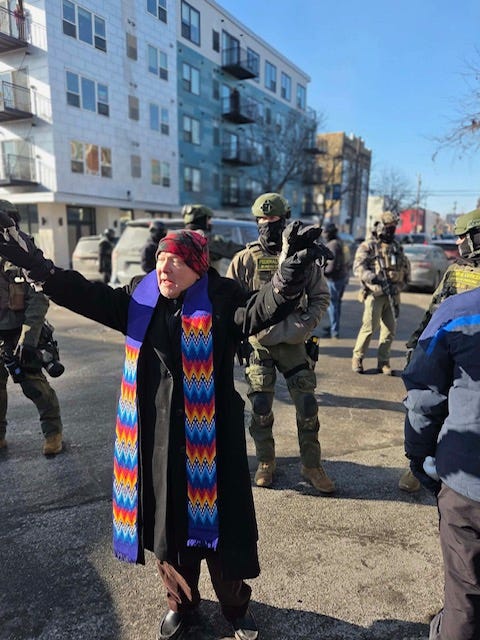
In Minneapolis, ICE and CPB and DHS agents arrive in our neighborhoods in rented vehicles—the windows often illegally tinted to opaque—to terrorize. This is not an immigration enforcement operation as they claim, and the proof of this—the evidence—is that we are capturing it with our phones and eyes. The agents act as if Stephen Miller’s promise of complete immunity were not decree but something they embody with their jungle camo, their tactical gear, their flashbangs and teargas and pepper balls and rubber bullets and Glocks and SIGs and ARs and balaclavas.
Federal agents are here to provoke responses that will allow them to justify lethal force against the peaceful, and because they do not encounter the responses they seek, they punch, knock down, swarm, beat with fist and buttstock and handgun and teargas canisters. They spray chemical agents in faces at point-blank range. They are always advancing on, advancing on, advancing on. They abduct without cause. They imprison without charge. You might be five years old waiting for your dad to pick you up after school. You might be a citizen with your papers on you. The agents could give a shit less. They are not here to enforce any laws. They are here to terrorize such that, terrorized, the populace will submit. As many have been saying, the cruelty is the point.
Where ICE alights come the whistles and honks and crowds. Outnumbered, ICE retreats behind walls of teargas, leaving behind vehicles, unused teargas canisters and flashbangs, fully loaded magazines.
The whistles are a siren call. You will drop everything upon hearing one and will go outside to bear witness, to resist with your body, to record with your phone. You are a new kind of first responder.
Many businesses are operating under protocols like those they invented during the COVID-19 pandemic. Doors are locked. You knock to gain entrance and are asked by a neighbor, a fellow freedom fighter, “Are you a federal agent?”
“Fuck ICE,” I have discovered, works well to unlock the doors.
Menus at the restaurants that remain open are limited to basic offerings. The regular kitchen staff, the brown people who prep and cook so much of our food, are afraid to leave their homes. They are US citizens. They are afraid to leave their homes.
Some restaurants and cafes are giving everything away for free. They accept free-will donations to pay staff. They are giving away their food for free so that they do not have to collect taxes that support the agents of ICE, CBP, DHS.
At night, many of us gather outside the hotels where ICE, CBP, and DHS agents are staying, making noise with musical instruments—a full drum kit at one place, brass bands and heavy metal bands at others—to make it hard for the invaders to get sleep or rest.
Just as a cakemaker, per the MAGA/Roberts majority on the Supreme Court, need not make a cake for gay people, we kick ICE/CBP/DHS out of our gas stations, restaurants, and other places of business. Companies that support ICE/CBP/DHS are listed and shared and boycotted.
I have thrown away well-worn favorite T-shirts that bear the names of local restaurants who by serving ICE/CBP/DHS are now complicit.
First thing in the morning, we open our Signal apps and check both our rapid-response and information groups. The rapid-response groups are for those currently active on the streets or at home coordinating those on the streets, providing info and guidance like air-traffic controllers. If we have been away from the app—working, say—when we return and open it again there are hundreds of posts in each of the groups we are in. We click to fly past the old posts to get the most recent and scroll in reverse chronological order until we feel caught up to speed. In between the posts with information on ICE sightings—between requests for license plate checks or urgent calls to gather with whistles and phones to stop abductions in progress—are lists of those joining the groups. Always, every time you check, more and more people are joining, the names in centered lists that remind me of Rorschach tests. On Signal, we know each by pseudonym, none of us using our real names, the pseudonyms, like the nicknames of soldiers, often providing needed comic relief.
We know ICE is in our groups and are wary that ICE may be in the meetings, where we have not known the people in our groups for very long. We end Signal chats and start new ones, whack-a-mole style. It strikes me that this has been the case with resistance movements forever, the assumption that certain communication channels are compromised but still necessary, good tools even if the wrong eyes are on them. It is a kind of dance.
There are communication channels that are safe safe, where we know ICE is not present. This is where more and more of my friends who I would never think would arm themselves are asking about how to acquire guns and training. They ask about whether to get long guns or handguns or both. They seek information on left-friendly conceal and carry permit and shooting courses.
Too many—one would be too many, in my opinion—chastise those whose resistance, as they see it, is limited to posting on social media, is not front-lines resistance with the body, with physical presence. They write in their own posts that people “need to do more than post!”
But in-fighting and a yearning for the sort of normalcy that is going backwards rather than forward kills resistance movements. Posting on social media is a start and can also be an important end. It reflects a mindset gone public. It is probably true that once the mind is infused the body tends to follow. It is probably true that social media posts can improve mental health and make us stronger individually in the long run, for the long fight. For me, social media posts are our barbaric yawps—our calls in the forest that we hope the likeminded somewhere else in the forest hear, echoing till another calls back and we fill the air with the prosaic song of resistance.
When Billy Bragg—the singer-songwriter with busking roots from the punk vein going way back, who has more than a little bit shaped my politics and understanding of injustices worldwide—writes a song called “City of Heroes,” not about Soweto or miner’s strikes or the Soviet Union but Minnefreakingapolis, I well up, hard, memorizing lyrics for singing along when he comes to town next:
When they came for the five-year-olds,
I got in their face
When they came to my neighborhood
I just got in their face
I will bear witness to terror
I will bear witness to tyranny
I will bear witness to murder
I will bear witness to fascism
I could not have guessed how much these things would sustain me, how necessary they would become. The history of resistance postering, of resistance graffiti, et cetera, is as long as the history of resistance. It is how we build an identity to stand against the identity of an enemy—who wears a red baseball cap today—who is already well established. And that identity feeds us.
The old-school punk rockers, by the way, were right about pretty much everything.

Our response as a city is built upon our response to the murder of George Floyd outside Cup Foods in South Minneapolis in the spring of 2020, when protesters converged at the intersection of 38th Street and Chicago Avenue and then along Lake Street, many wearing masks, trying to social distance. The protests were met by militarized violence from the MPD—tear gas, pepper spray, flashbangs, rubber bullets. The protests became riotous. Fires were started, businesses looted. Opportunists catalyzed the violence against the neighborhoods and their establishments. In a widely circulated video, a white man dressed in black and carrying an umbrella and hammer smashes the windows of an AutoZone shop, one of if not the first buildings set on fire. The man flees as nonviolent protesters questioned him and his actions.
Vehicles from out of state or with no plates were spotted in many neighborhoods. Homemade incendiary devices were found stashed in alleys and backyards, planted during the day for use at night.
On May 28, 2020, police abandoned the third precinct building in South Minneapolis, leaving it to be burned. The many who speculated that the MPD deliberately abandoned the neighborhood to let it burn found their speculation bolstered the following night when the police amassed to protect the fifth precinct building. A Minneapolis City Council member wrote to describe how the MPD systematically delayed response to calls to blackmail the council into passing budget increases. The nights were filled with sirens, choppers, bangs, booms. Curfews were announced. The burning and looting expanded to St. Paul.
The residents of South Minneapolis felt abandoned. The neighborhoods organized, held mass meetings in public parks—Powderhorn Park, Martin Luther King Park, others—and developed plans for our self-defense. We packed evacuation bags, went on patrol, used social media and our smartphones to warn each other of suspicious vehicles, activity, people, packages, containers, and so on. We watered our lawns down so that they would be harder to burn. We left our lights on and brought our trash receptacles up or in, or filled them with water, lest they be set aflame.
During the day and before curfew, couples and families walked their dogs. They were doing more than exercising themselves or their pets. They were our eyes and ears. Those with guns had them ready.
On another of the nights, five or six cars drove down my street at intervals of perhaps ten seconds, perhaps twenty seconds, a kind of battle formation. The cars bore no license plates, were painted all black with the windows, except for the windshield, blacked out. Another night the same number of blacked-out motorcycles proceeded in the same battle-ish formation, again at intervals of about ten or twenty seconds. The gossipy Nextdoor app was used to identify and trace suspicious vehicles from neighborhood to neighborhood, a kind of citizen-brigade democratization of the surveillance state. Everything I had read—which was a lot—regarding the desire of the white power movement to foment strife and eventually civil war, to come together when the time was right, felt like it was happening, like Minneapolis had become a gathering place.

There is a lot of blurring between then and now and also some very important differences. The Proud Boys and Bugaloo Boys and other white power groups who were acting as accelerationists in Minneapolis and St. Paul in late spring 2020 and as insurrectionists at the US Capitol in Washington, DC, on January 6, 2021, are now the ICE agents on our streets, here less for the $50,000 bonus payable over five years in 10K increments (meaning a next president if the union lasts will have to sign off on the whole shebang for them to cash in on all of their blood money) than for the opportunity to be the monsters they are with impunity. Pick your favorite historical secret police force. ICE is its descendent.
I write to you under a big “London Calling” poster I’ve had since renting my first apartment in my early twenties. On the poster, Paul Simonon of The Clash is frozen in black and white, his bass guitar overhead like a great ax, his legs wide. He is perpetually ready to bring it down and smash it—as if on a Grecian urn—and in doing so smash all that needs smashing in this world.
If things go south, I want you to know what we have done, what we’re doing. If like me you graduated from high school in 1984, it’s hard not to think back to the movie Red Dawn and compare what we’re doing here in Minneapolis to the Wolverines, the kids in Red Dawn who became guerrilla fighters after NATO was disbanded and the Soviet Union invaded their Colorado town. The kids lose the short game but win the long one. The movie ends with a shot of a plaque on a rock that says, “In the early days of World War III, guerrillas, mostly children, placed the names of their lost upon this rock. They fought here alone and gave up their lives, so that this nation shall not perish from the earth.”
They were decentralized, leaderless, a pod among many pods. They learned by doing, on the fly. It is like that here, too.
Experts who study civil wars have published pieces calling this the start of one. This is fascism, and you have to call it what it is. What the Trump regime has visited upon Minneapolis and Minnesota is an unwelcome visitor. Trump wants a small civil war to break out in Minneapolis so that he can call in paratroopers—the power of the US military—to quash it with martial law, ending the republic and replacing it with a model Putin would love. And he will not stop with subjugating the US. He will expand, just like Putin.
Fascism never stops in one city. Fascism doesn’t stop until the people stop it. In the early days of fascism, when it hasn’t yet come to your city, your town, your countryside, all seems normal. It has always been this way. The playbook is very old.
Here’s how it is on the ground today, January 31, 2026: Greg Bovino, the chihuahua-complex Nazi, has been replaced by Tom Homan. Mainstream media are reporting that this will lead to a de-escalation, a drawdown of ICE/CPB/DHS presence in Minnesota.
In the vacuum that is a sigh of relief, the intelligence we are receiving indicates that Secretary of War and Minnesota native Pete Hegseth—who I have it on good word, from a primary source, is loathed by his extended family—has signed off on expanded operations.
ICE/CBP/DHS, our intelligence says, are amassing here in number, quartering more territory, bringing in more of the munitions of war, like the LRAD sound cannons already reported to have been deployed in the suburb of Maple Grove. The fear is that what you see now will seem like nothing when the amassing turns into operations on the streets.
ICE/CBP/DHS have teamed with the tech bros of Palantir and their ilk to track us. Almost all of us are hyperconnected and carry smartphones that tell them exactly where we are, all the time. Legal and constitutional observers—anybody, really, who isn’t wearing a MAGA hat or the nouveau-Gestapo gear of ICE or similar branding—are photographed and databased by ICE/CBP/DHS agents for the purposes of tracking, for the purposes of hunting down. Our vehicles are tagged and traced. They know where we live. The Minneapolis mission goes beyond the targeting of the brown-skinned to targeting the any-color-of-skinned who dare call into question, who dare to stand up for democracy and the rule of law, who dare to witness.
They surveil in order to exact retribution for witnessing. It seems Alex Pretti was in their sights for at least a week before they had him where they wanted him and could make, as they see it, an example of him. As one proudly unmasked ICE agent recently said to the person filming him—likely now a target—“You raise your voice, I erase your voice.”
Some of us contribute to the resistance by participating in food distribution networks. We get lists of the needs of various Anne Franks from human sources, not on the group apps. We buy what they need and meet those who will do the distribution, the feeding, the clothing. We do not know who will deliver the food, the clothes—whatever they need—nor where they will deliver it to. It is better not to know.
ICE/CPB/DHS agents, the intelligence says, are following the white-skinned when they leave grocery stores, hoping they will be led to an Anne Frank. Eat the piece of paper you’ve written the address on.
It is better not to know.
Somehow, life continues as usual. If you are not where ICE/CBP/DHS agents and their convoys have decided to deploy, things can seem normal, pre-ICE. If you are where the agents have deployed to terrorize, you are a likely candidate for PTSD.
After a massive and uplifting general strike in Minneapolis on January 23, with a reported 50,000 people marching downtown and many thousands more in smaller marches and gatherings on a day when the low temp was -21ºF, we woke the next day to news that ICE/CPB/DHS had killed another of us. I saw the first video taken from Glam Doll Donuts on Nicollet Avenue. I saw it for what it was, for what those who shot the footage, who can be heard on the sound clip, saw for what it was: the bloodlust execution of Alex Pretti.
In other clips released later, ICE/CPB/DNS agents in the immediate aftermath of the execution clap to say job well done. A doctor—a pediatrician who ran from her apartment in the neighborhood to provide assistance on the scene—testified that the agents counted bullet holes in Pretti rather than checking for signs of life or providing potentially life-saving assistance. She told The Independent, “I am not sure when I will return to my apartment. I do not feel safe in my city. In less than one month, ICE agents have shot and killed two people for protesting and observing their actions. I worry that I or someone I love will be shot and killed for voicing their displeasure and being in the wrong place at the wrong time.”
In another clip of the immediate aftermath ICE/CPB/DNS agents say in range of a hot mic, “It’s just like Call of Duty. Pretty cool, huh?”

A call for a citywide candlelight vigil to honor and memorialize Alex Pretti on the night of his execution is shared widely. If it’s too cold for people to be outside, the call says, they can leave candles on their stoops.
I walked outside at five to seven, the time of the vigil, to see what was happening. The air was frigid but still. I was well bundled—all but for my face. I saw candles on stoops, usually two, one for Renee Good and one for Alex.
Two and a half blocks away I saw a bunch of people holding candles at an intersection. I started to walk toward them. A few others came out from houses, condos, and apartments along the way. They must have received notice that didn’t make it to me of this particular gathering, which I found by accident. We all walked toward the candles and people on the corner.
By the time I got there, the vigil was underway. A woman who said she was a restaurateur—I think she runs the Creole joint on the corner—was leading the gathered in a simple, short singalong. Old people. Kids. All ages between. Most were singing. It was easy to pick up the lyrics. The woman called them out. We responded.
After a few times through the woman stopped leading songs and talked to us. She told us she had attended singing resistance training earlier in the day. This was her first protest. She asked us all who was from the neighborhood? Minnesota? First protest? Protest vet? People raised hands to answer.
I’m guessing there were maybe twenty-five to forty people in all who gathered, a broad range because not everyone stayed for the whole time, due to the cold. The numbers were fluid and I didn’t think to count until after I got home, from memory.
We did what you do when it’s this cold out and you are stationary. We stamped our feet. We held our mittens to faces, blowing to warm them.
The candles people held were both real and battery powered. Some sang and some didn’t. A pattern was established: Sing a few rounds of a simple protest song, provide time for people to say what they need or want to say. The woman leading kept asking if anybody else had songs they wanted the group to sing.
One close friend and another coworker of Alex Pretti told us about him. The close friend stayed only long enough to present his eulogy and then left in a car. My guess is he drove from vigil to vigil to share what he had to share about Alex, driving through the night towards gatherings of candlelight.
An older woman told us how most of her family had been killed by Nazis in World War II. She said that it’s starting the same way here, now.
I shared some fresh info that I’d gotten on new ICE/CBP/DHS tactics.
One man during a singalong yelled “she’s on fire” when candle flame ignited a woman’s long blond hair. After the fire was tamped out, the woman put her hand on her kid’s head. The kid was standing in front of her and came up to a bit over her waist. She smiled and said, “It’s just hair.”
Somebody from the crowd asked if we could sing “Amazing Grace” and the woman leading said “Sure!”
I love “Amazing Grace.” I always have. I know the words to more than just the first verse.
We started singing, and I planned to be a big voice. And I tried to be that, a big voice, but I discovered on the first note that I hardly could get the words out. Whenever my mouth tried to make music of those words I know so well, it felt like I was going to bawl. Like I was going to break down.
So I was a small voice in a small gathering. I wish I could have seen the city from the air. How many others were thinking the same?

My maternal grandfather—my Grandpa Greg—a soldier in the 95th Infantry, the Victory Division, landed at Normandy a month or so after D-Day, the first mission to drive from there through Paris to the front and back, bringing supplies, returning with casualties, with the dead. As the Nazis retreated, my Grandpa Greg and his division went north to first liberate Metz, a city that had not been taken by siege for more than fifteen hundred years, earning them the nickname the Iron Men of Metz. They would then go further north, through Luxembourg and Belgium and into Germany, engaging in heavy urban fighting as they won the Ruhr Valley. My grandpa’s unit, the 378th, was one of those that discovered camps and forced the local “good Germans” to witness what they had been living next to, what they had been smelling, making them bury the dead.
There is old war footage of my Grandpa Greg’s regiment on the streets of Metz and in the Ruhr Valley. Most of the footage is of soldiers securing places they’ve captured. Some of it depicts battle, a few gunfire volleys.
I can’t help but compare it to the videos of the clashes in Minneapolis between residents and Trump’s secret police. The violence in the color footage from Minneapolis is crueler and more continuous, is more depraved and indiscriminate than in the black and white footage of the soldiers in WWII.
The good guys now are not the ones in the uniforms but those in civvies.
My Grandpa Greg was a devout Catholic. He had always been a Catholic but I wonder how much the devoutness increased after his service in the European theater? If you ever spent the evening with my grandparents, you prayed the rosary. Often they would take a drive around the small midwestern town they lived in, praying it bead by bead. They prayed it the same way it was prayed in church before mass. Grandma Mary would start the Hail Marys and Grandpa would finish them. If you were visiting, you joined Grandpa Greg.
Grandpa Greg promised his God that he would pray the rosary every night for the rest of his life if he made it back home alive. Though he enlisted and wasn’t drafted, he must have been afraid for his life, afraid of losing it.
Grandpa Greg was a young man then. I am becoming an old man now, and the arrival of tyranny on the streets of my town—plus my accumulated life experiences, I guess—has brought a gift like no other: I no longer fear death or dying.
I do not plan to die. I am not going to put myself in a place to die, am not going to court death, am not going to be reckless with my one wild and precious life. But neither anymore do I fear it.
I read a lot of Marvel comic books growing up, and although I am well past the age of inclusion in that universe, I feel like this is my origin story, that I have been deposited deus ex machina style into issue number one.
There is no radioactive spider bite. No gamma rays. But a new superpower is mine.
About the author:
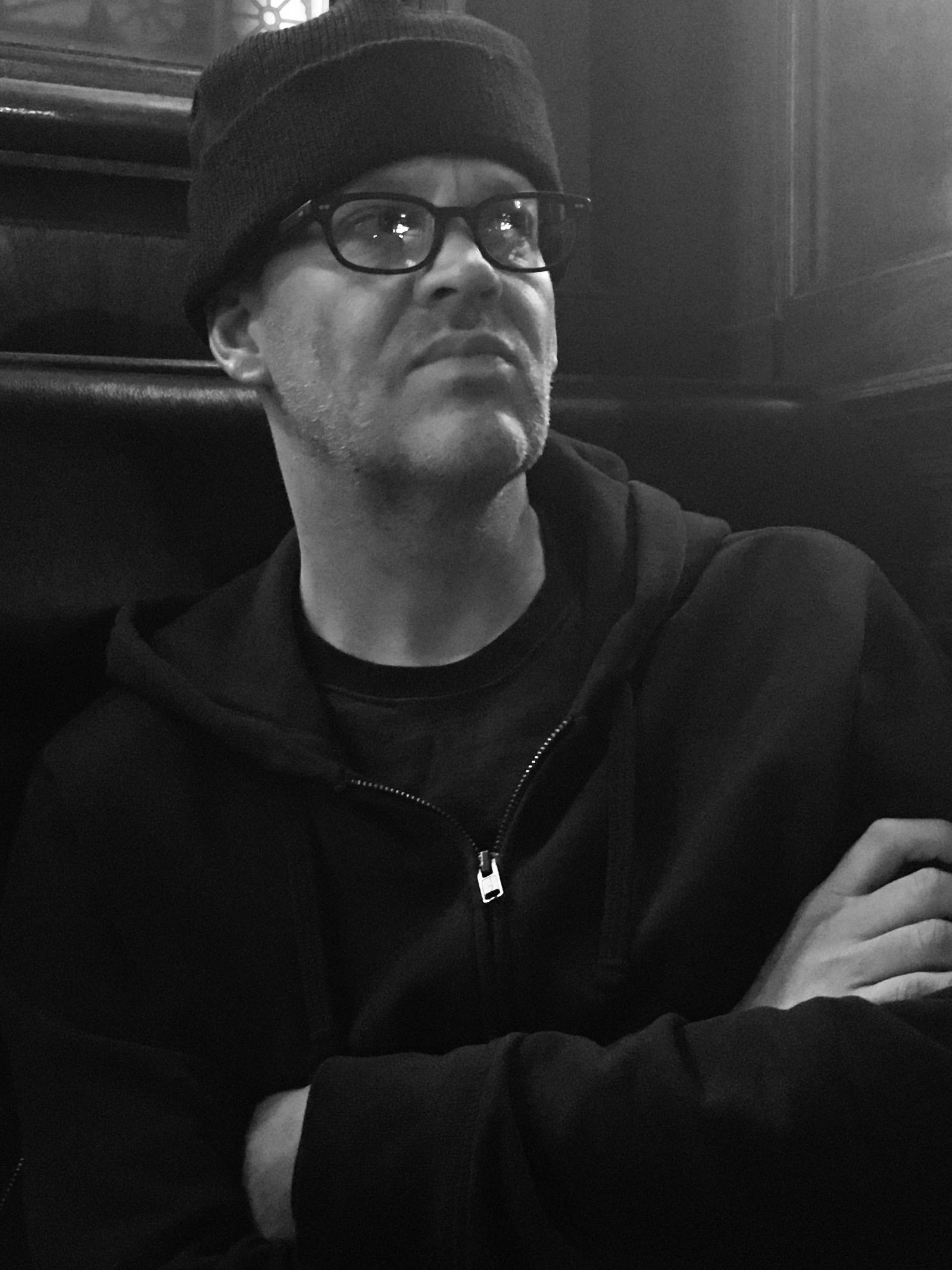
Matt Mauch is the author of five books of prose and poetry, including the hybrid memoir A Northern Spring. Mauch’s work has appeared in numerous journals and has been recognized by the Minnesota State Arts Board and as a finalist for National Poetry Series and other national and international contests. Mauch lives in Minneapolis and teaches in the AFA in Creative Writing program at Normandale Community College. He and his books can be found online at mauchmauch.com.
Cover photo used with the permission of Jeanne Minnick. The editors of sneaker wave magazine are so grateful for her work.
Matt, this is brilliant. And sad. And devastating. And inspiring. Thank you.
Painful and frightening read but an important one. It's good such a wonderful writer can document what is happening in MN with such intimacy but also connect the dots to the larger historical human picture.