


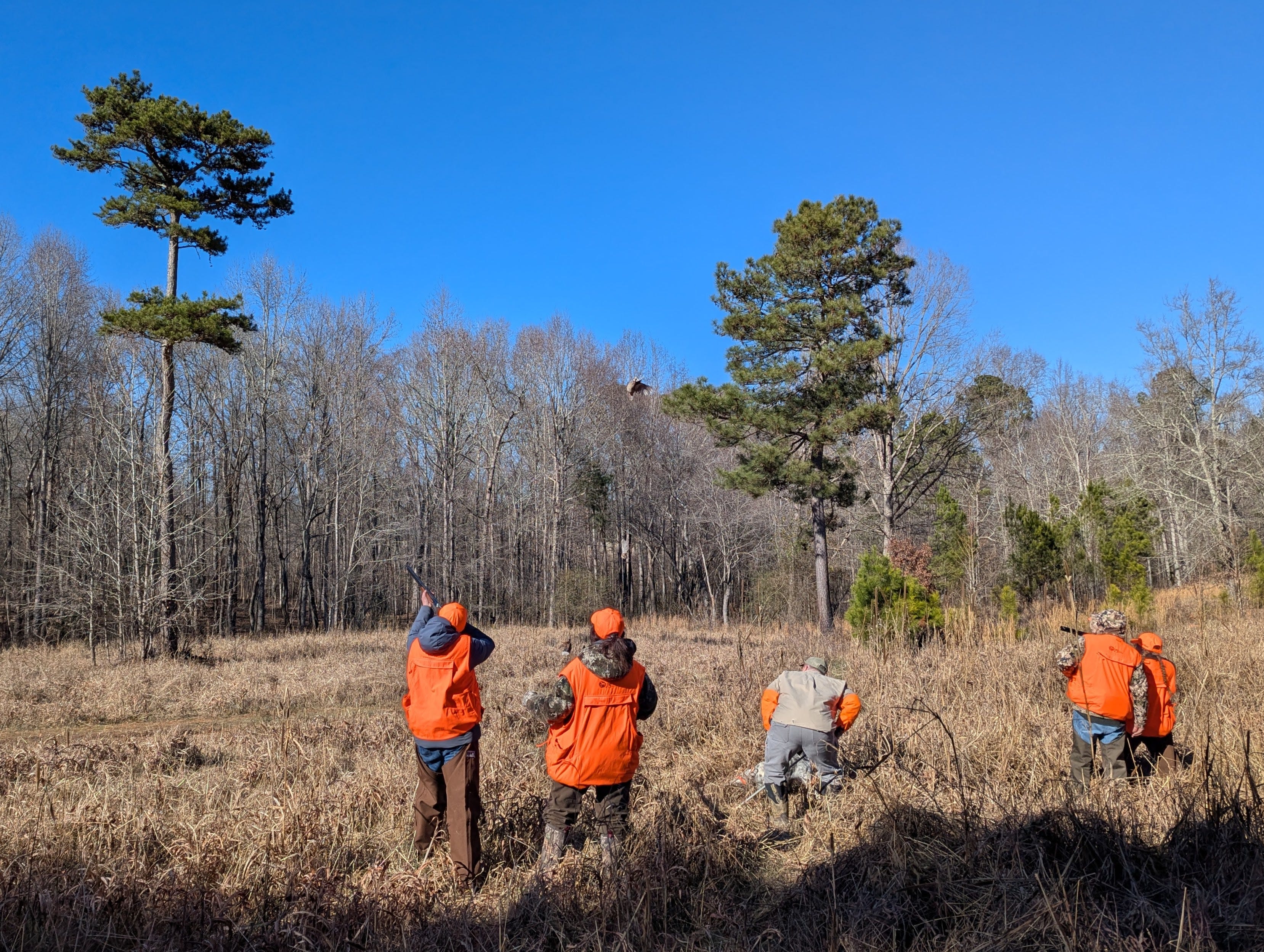
IN JANUARY OF 2026, I stood downwind of a young woman while she shot the head clean off a bobwhite quail. We were part of a small hunting party stalking the woods of a plantation near Social Circle, Georgia. My cell phone, poised above my head so I could take a photo of the hunter, failed to shield my face from the ensuing spray of white feathers. Our hunting guide laughingly called it “Georgia snow.” Everyone chuckled at the unexpected decapitation, and the shooter, a state worker from New Jersey, apologized for the feathers. The flurry bothered me less than the close-range shotgun blast that still rang in my ears a minute later. As someone who’s easily unmoored by loud noises, the gunfire put me on edge. I’d asked one of our guides for earplugs earlier in the day, but he said they were prohibited during the hunt so we could be sure to hear safety instructions from one another.
I wiped the odd winter “snow” off my face, then followed the rest of the group into the brush to look for the newly headless bird. We wore blaze orange vests and thick, leathery chaps to shield us from the brambles in which the dull brown quails liked to camouflage themselves and which were surprisingly prickly. (Later that day, once it warmed up, I removed my gloves and soon got a bloody scratch on my hand.) The Jersey girl spotted her prize and grinningly placed it into her vest pocket, where it joined two other quail she’d already downed with her weapon. Another novice hunter in our party, a woman from Oklahoma, had shot and pocketed one bird so far. I was a student hunter like them, but that day, instead of shotgun shells, I’d chosen to shoot only pictures from my phone.
Our group of newly certified and licensed hunters consisted of the twenty-something New Jersey sharpshooter, the thirty-something Oklahoman, and me, a forty-two-year-old woman hailing from Oregon. The guided bird hunt was a sort of capstone project for a week of intensive study and field exercises. A total of eighteen early- to mid-career government workers from around the nation had gathered in a classroom to learn about why and how people hunt game animals in the United States. The curriculum was geared toward people with no hunting experience, which described the vast majority of us. Many of us had never even held a loaded weapon. I had spent one day shooting guns in the forest with a friend, years ago, and didn’t care for it.
All of us had careers at natural resource conservation agencies ranging from IT support (which is my job) to wildlife biology, from finance to communication. Our employers had sent us to this workshop to learn more about the methods and motivations of our hunting constituents. There was no stated intent to recruit us into hunting—only to educate—but I started the week with a keen interest in learning, and with the seedling of an idea that I might even like it. I already enjoy being outdoors, although I’m more familiar with what conservationists call non-consumptive uses of nature: hiking, biking, beachgoing, and passive admiration of animals. I was curious about the kind of person I would evolve into if I took up hunting. It would certainly throw off people who think they know me, like my aunts who were surprised, years ago, to see their quiet, straight-laced niece become the first person in the family to get a tattoo.
If I was a hunter, I’d have an excuse to get outside more and strengthen my tenuous claim to being “outdoorsy.” I’ve been trying to hang onto that claim, if only in my own mind, since my young and single days when I spent a lot of time riding my bike and hiking in the woods. Now it’s hard to maintain an outdoorsy lifestyle with a husband and young child who prefer being homebound. I was intrigued to learn from the panel of hunting instructors that they would sometimes go on a “hunt” with no intention of shooting anything. Even game and bird hunters go outside for peace and quiet, to enjoy a hike through the wilderness, or for camaraderie with friends and family. I thought about the bikepacking trips I used to take with friends. Like hunting trips, those outings required specialized gear, except we carried that gear on bikes instead of on our backs. We all loved riding bikes, but the experience was less about the act of cycling than it was about the freedom of being outside while enjoying each other’s company.
I also appreciate the desire to feel closer to nature by developing a deeper knowledge of animals, even if that insight is ultimately used to kill them. Most of our instructors were trained biologists as well as hunters, and they clearly respected the game animals they pursued. They taught us a range of things that hunters need to know about their quarry: basic species recognition, as a starting point, to ensure you’re chasing the right animal. Knowledge of the critter’s habits and footprints to help you track them in the wild. Familiarity with their anatomy so you get a clean kill shot.
We received a lot of instruction and practice with various firearms in preparation for the hunter education exam that would grant us our Georgia bird hunting licenses. Our training facility was a small compound of plain-looking classroom buildings nestled in a nature preserve, as well as a lodging section that resembled a budget motel but with a beautiful view. We attended lessons late into each evening, crashed in our separate rooms, then woke up early to meet for breakfast in the dining hall and wait for the director’s bellowing call of “Five minutes!”, which was our signal to finish that cup of coffee and head to the classroom for the morning lecture. The instructors made full use of our limited time and space by devoting every corner of the compound to a different workstation. They even set up a table of guns and ammo in the tight hallway of the motel. In a very hands-on way, I learned about rifles, shotguns, and muzzleloaders, and how to measure the size of ammunition going into each one. I learned how to load ammo into guns with lever, bolt, break, pump, and semi-automatic action. I learned how to hold a gun and walk around with it safely, then bring it up to my shoulder in a single, quick, fluid motion.
In the main classroom, after nightfall, our instructors turned out the lights and used a laser pointer to trace the path of an imagined bird across the darkened wall. My job was to mount a real, unloaded shotgun using the stance I had practiced with a dummy gun, then pretend to shoot the moving target. Everyone had to participate, but I put myself at the end of the line and secretly hoped the evening would grow late enough that somebody would call for bedtime. Even with no ammunition and no bird, I got nervous as I put my finger on the trigger and said “bang!” I was the only woman assigned to that corner of the classroom, and I disliked being watched by the men—most of whom, I’d learned over the past few days, had prior experience with firearms and sometimes chimed in with “helpful tips” during class time. I didn’t truly think they would judge my lack of skill, but I worried that they could see the unease showing on my face. I wasn’t relaxed and jovial like them; I was still scared of guns. I wasn’t cool yet.
Over the course of three days, we graduated from toy-like wooden firearm models to lightweight unloaded weapons to heavy shotguns loaded with inert shells. I became fairly proficient with getting myself into a shooting stance, but the act of putting a real gun up to my cheek, even when it was harmless, made my heart race every time. The weapon’s heft was intimidating.
By the time we progressed from the classroom to the outdoor shooting range, I hadn’t decided if I wanted to participate in the final day’s quail hunt. It wasn’t mandatory, although everybody was required to come even if they didn’t carry a shotgun. I couldn’t think of any logical downside. It would be a new experience, possibly very exciting, maybe revealing a hidden desire or skill. Maybe my nerves would calm down with more practice, and I’d be able to focus and pull off an amazing shot, like the way my focus sharpens when I’m under a deadline at work. If I managed to kill a bird, I’d be able to take it home to my freezer and cook it, fulfilling two moral imperatives that nag at the edges of my convenient life: to harvest my own food, and to eat meat for which I did the dirty work.
But I wanted to see how I did with target shooting first. Fifteen years had passed since that day I’d gone shooting with a friend in rural Oregon, when my discomfort had been palpable. (“She’s from California. I think she’s doing alright,” I overheard my friend telling his buddy, as if my California breeding explained my timidity.) I reasoned, dubiously, that maybe I’d be more confident handling a firearm now that I was older and generally more self-assured. And if I fumbled it, that would be okay. At my age, I’m not supposed to care anymore what people think of me.
The class broke into smaller groups so instructors could shepherd us through different stations at the range. Tin birds and cardboard squirrels sat placidly as we took aim at them with tiny pellets launched from air rifles. I managed to clip a couple of metallic bird wings with my weapon, but the squirrels remained unharmed. At the adjacent station, I channeled my inner Ralphie Parker, learned how to load and shoot a Red Ryder BB gun, and aimed at soda cans strung up in front of a tarp. I mostly missed. Although I didn’t find a secret talent for marksmanship, I actually had fun firing those lightweight guns.
After the soda cans, we moved on to live shotgun practice. As open-minded as I was trying to be, I’d been dreading it all day. Visceral memories came up from that old shooting excursion: the terrible loudness of shots echoing through the woods, the vulgar feeling of holding a deadly AR-15 rifle, and my general misfit status among men and their boys who enjoyed guns. I was momentarily reassured to be paired with a woman mentor at the range. She escorted me inside a small, three-sided wooden shack that was open from about the waist up. That opening allowed us to position the shotgun barrel outside and sweep it from side to side within a safe zone of fire. I donned foam earplugs and stretched a beanie over my ears. I was afraid of the noise and hoped the hat would offer extra protection—also, the January air was freezing cold.
My mentor started by reviewing the shotgun stance we’d been practicing for days. Then she handed me an unloaded weapon and got ready to launch a couple of clay birds for me to mock-shoot so I could rehearse the motions. I said “Pull!” and she stepped on a trigger to release the clay. A bright orange disc flew downrange like a bird trying to escape into the bushes. I tracked it with the end of my muzzle, moved my index finger onto the trigger, followed through, then pointed the gun back down. I didn’t say “bang!” this time. I wasn’t confident that I’d really be able to squeeze the trigger when the time came.
My heart thumped nervously as I signaled to the mentor that I was ready for live ammo. She loaded me up with two 20-gauge shells, one for each barrel in the shotgun. I got into a ready stance and said “Pull!” The clay took off, and I brought the gun stock up to my cheek while switching the safety off in one (relatively) smooth motion, like they’d taught us. I pulled the trigger, and BANG! I was not prepared for the explosivity. My right earplug had come loose as I’d cocked my head, so the boom sounded louder than expected, and I panicked at the sheer power of the weapon in my hands. I took a moment to breathe and fix my earplug, then told my mentor to pull again, eager to get this over with.
I hadn’t hit my target the first time. With the second shot, I hit the edge of the clay bird, but didn’t feel gratified at the sight of it breaking into pieces midair. My breathing grew anxious, and I was on the verge of crying. I loosened my hold on the gun and said, “I don’t think I want to shoot anymore.” My mentor said that was totally fine, but didn’t quite know what to do with me as I sat on a nearby bench and let a few tears fall out. She approached me tentatively, said, “I don’t know how to help you right now,” and walked away with her hands clasped at her backside. Apparently there’s no crying in shooting sports.
I felt like a complete dud. Everyone else was loving the shotgun practice. Right in front of me, an administrator from the Georgia Parks Department was blasting clay after clay and jumping up and down with glee. My mentor, having no mentoring to do, started walking around and cleaning up shell casings. After our time was up, a fellow student noticed my trouble and asked what I struggled with. She seemed baffled that I hadn’t enjoyed the shooting. I generalized it as “too loud,” not really in the mood to explain myself. Inside my fully grown body, I was still a child too sensitive to fit in.
The next morning, as we assembled into groups for the quail hunt, it was clear that I needed to be the group photographer and not a shooter. I was apprehensive about being near live fire, but relieved that I’d probably never have to handle an actual gun again.
I walked into the sunny woods that afternoon with a party of two student hunters, two shooting mentors, one hired guide, and the guide’s two eager bird dogs. The dogs trotted through tall grasses and sharp brambles without a care, dutifully following orders—which the guide yelped in a thick Georgia drawl—to find where the birds were hiding. When a dog stopped and pointed, forming a motionless arrow from nose to tail, the guide would gesture for us to get closer and for the hunters to get ready. Then he’d use a cane to flush the quail from their grassy shelter. That’s when I would typically raise my hands to cover my ears, while either the New Jersey biologist or the Oklahoma GIS analyst took their shot at the birds. My sensitivity to noise did not make me a good action photographer, but I took many pictures of our group walking among beautiful scenery.
I enjoyed the experience as a day hike, but also, surprisingly, shared the thrill of the hunt as an observer. Everybody was cheerful and swelled with a collective sense of pride whenever one of us shot a bird. We buzzed with the good luck of getting paid to be outdoors and earning this respite from our ordinary desk jobs. I came out of it with no particular distaste for hunting, even after observing (and helping with, a little) the process of cleaning the dead birds back at camp. I have nothing but respect for the hunter who leaves no trace, harvests their kill ethically, and utilizes the animal for food, hide, or fur. It’s not a pastime for me, but I might be willing to join a friend on a hunt someday.
My fellow students harvested almost fifty quail that day and packed the frozen birds into suitcases to travel home in planes and cars. The Jersey girl offered me one of hers, but I declined. Instead, I brought home a scratchy throat that evolved into pneumonia. Damn Georgia snow.
About the author:

Kristen Martin is a systems analyst who likes to counterbalance the logical nature of her career with bouts of creative writing. She is overjoyed to realize her childhood dream of being a published author. She lives in Salem, Oregon, with her husband, son, and crazy pets. Find her reflections on life and parenthood at www.thisunquietmind.com.
The artwork for this piece was taken by Kristen Martin.