


AT TWENTY-SEVEN, YOU LAND your first corporate job. Working in a call center isn’t exactly your dream career, but it’s also one of the few options in your small hometown for someone with no college degree. On your first day, you pin a plastic employee badge, along with your hopes for a sunnier future, to the space above your heart. You’re determined to make this work.
The starting salary of $25,000 is more than you’ve ever made in your life; the thought of that first paycheck makes you almost giddy with possibility. Now you can afford to pay the electric bill on time and buy new soccer cleats for your son, to be worn in games you’ll no longer be there to see.
In training class, you and the other new hires spend two months getting paid to watch instructional videos and eat snacks. On the day you graduate, the instructor presents each of you with a certificate of completion and a little box of generic office supplies: paper clips, Post-It notes, and a plastic headset with an itchy synthetic earpiece. “The Post-Its tend to go missing, so guard them with your life,” the instructor says. Your classmates nod earnestly.
The first real sign of what’s to come happens during the ‘commencement speech.’ One of the call center supervisors warns, “Remember, no one calls us because they’re happy and want to tell us what a great job we’re doing.” Uneasily, you realize that he’s right. Confrontation has never been your thing, but now it’s in your official job description.
During the interview, the recruiter said you’d be working 9-5. At the end of training, you’re assigned to the 11 AM-8 PM shift with split days off. This gives you one hour with your third grader before he goes to school in the morning and thirty minutes before he heads to bed in the evening. It’s not enough.

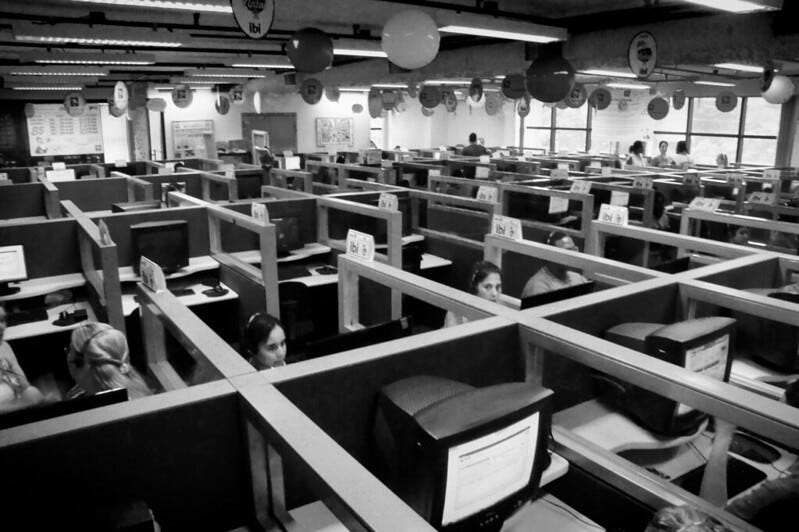
Unlike the training classroom, with its courtyard view and eggshell-blue walls, the landscape of the call center is as gray as the moon. Ash-colored chairs and cubicles stand in uniform rows from one side of the building to the other, forming a seemingly endless labyrinth. Near the water fountain, a pair of eagles soar above the word TEAMWORK; color has leached from the poster over time, and the once-majestic birds are now faded versions of their former selves.
The vending machine is a neon island in this sea of dull neutrals, its smooth metal rings coiled around shiny snacks made from high fructose corn syrup and red dye #40. Though vaguely food-shaped, they do not nourish or satiate.
In an attempt to break up the monotony, you tack the bright drawings your son brings home from school to your cubicle with green and yellow push pins left behind by the previous occupant. These carefully crayoned paper trees and rainbows provide a bit of cheer as you take your first, eleventh, and thirtieth calls of the day. Only the supervisors have window seats, so you sense, rather than see, the light of the sun fading. It will be dark by the time you leave.
In training, you and your classmates developed an easy camaraderie, with plenty of time between assignments to get to know one another. You all hoped to be assigned to the same team, but now your classmates are lost somewhere in the cubicle maze and you’re surrounded by tenured employees with no time for friendly chitchat.
There is a constant low buzz in the call center. The people around you are obscured behind cubicles, but their voices carry. You learn a lot about your new neighbors during those first few weeks: who curses at customers under their breath, who shows up hungover, who spends breaks hissing into their cell phones about custody battles or shitty boyfriends. The woman in the cubicle to your right charms callers with her easy laugh, presses the mute button on her headset to wonder aloud at their stupidity, then returns to the line just in time to say “I understand your frustration.” This line is delivered with such sincerity that you initially mistake her for two different people.
Between calls, your coworkers leaf through magazines with glossy covers. Inside, smiling celebrities carry handbags that cost more than you make in a month beside the caption: Stars, they’re just like us! Other articles offer easy crockpot recipes and simple moves to wow men in the bedroom.
You wonder if your coworkers have the energy to wow men when they get home, or even to stir whatever’s been sitting in the crockpot all day. Weariness permeates the call center’s atmosphere. Many suffer from the ailments of the desk-bound—tension headaches, carpal tunnel syndrome—and even during summer heat waves, they cocoon in thick sweaters to compensate for poor circulation.
Lunch breaks are scheduled at random times every day, so you eat anywhere between 11:45 AM and 4:30 PM. Breaks are purposefully staggered to provide call queue coverage; you rarely see anyone you know in the cafeteria. Employees aren’t supposed to eat at their desks, but you take to hiding snacks from the vending machine in your filing cabinet anyway, thrilling a little at this tiny, petty rebellion. The little bags of contraband cheese crackers are a shock of orange and red against the cold gray metal drawers.
Despite the fact that call center employees never interact face-to-face with customers, there’s a strict dress code. Dark neutrals are the favored professional wear, so most people roam the halls clad in black polyester, like the world’s most unfashionable goths. Aside from those who sit directly next to and across from you, you don’t even know what most of your coworkers look like. One back hunched over a desk is indistinguishable from the next. Although you all spend more time here than you do with your loved ones, you wouldn’t recognize each other in passing on the street.
You spend your days surrounded by people. How is it possible to feel so alone?
At the call center, employees are rated on how quickly transactions are handled. Payment calls are expected to take less than two minutes; more complex requests, four or five. The official company line is that employees should create an exceptional experience with every call, but the real goal is to get customers off the phone as quickly as possible. Success is measured on a merit-based ranking system; speed and quality scores determine eligibility for pay raises and shift bids. Occasionally, the highest performers are pulled from the phone queue and promoted to cushier jobs.
Call center reps are graded on a pass-fail system. If the customer is satisfied, you pass. If you transpose a digit while searching for an account number, forget to thank the customer at the start and end of the call, say “um,” place the customer on hold more than once, sigh, cough, or grow flustered, you fail. “I don’t know,” in any context, is unacceptable. “I’m not sure” and “I can’t do that” are also automatic fails. Other shortcomings, not on the official list, are up to the judgement of the quality specialists.
The idea that your every word is being recorded makes you deeply uneasy. Even before the call center, you’ve always been self-conscious, prone to second-guessing yourself in social contexts. Now, the quality reviews provide third-party confirmation of all the ways you’re getting it wrong. Every time you think you handled a call well only to receive a negative review hours later, your confidence wavers a little more.
During one call, the woman on the other end begins to cry: “My car’s in the shop, and I’m broke. Can’t you please waive the late fee just this once?” Technically you could—the button is right there—but car trouble isn’t on the list of qualifying life events, and going rogue could tank your quality scores. You apologize—polite, firm, detached—and feel sort of relieved when she hangs up.
The majority of the call center reps are female. There are a handful of men on the phones, but most seem to hold loftier roles: trainer, supervisor, quality specialist. In other words, the men make the rules, and the women follow them. If anyone else notices this, they don’t bring it up.
As a new hire, your call times are too long, and your quality reviews are often lower than everyone else’s. This does not go unnoticed by your supervisor, who calls you into his office one day to discuss. (‘Office’ is a generous description; it’s actually a cubicle, albeit one with high walls and a window overlooking the asphalt parking lot. Supervisors, they’re just like us!) He frowns at your monthly stats. “You know,” he says, “you really need to ask more questions. Call the help desk more—that’s the whole reason they exist.”
The following month, you rack up the most help desk calls of anyone in the entire department. As it turns out, this is even worse. The supervisor stops by your desk, tapping lightly on the cubicle wall to get your attention. Your face burns as he sighs, “You need to ask less questions.”
The well-worn adage ‘The customer is always right’ means calls often start with a list of demands before you’ve even gotten a name from the person on the other end. At your last job, working retail at a local family-owned business, you knew most of the regular customers well. Here, the callers are disembodied voices floating in from far-off places like Buffalo or Tampa or Glen Burnie. You never speak to the same customer twice. After a while, they begin to seem less like people and more like problems to be solved.
By the time a caller gets to you, they’ve already gone through an overly complex automated phone tree, rage-inducing in and of itself. They’ve endured the inanity of attempting to converse with a robot (“How can I help you today? You can say ‘Service,’ ‘Payments,’ or ‘Other’ . . . Sorry, I didn’t understand that. How can I help you today?”). Some of them are stealing away on their own lunch breaks to call you; others are sitting in traffic or wrangling small children with one hand while pressing buttons in an ever-increasing state of agitation with the other. And as you learned in training, if they’re going through all of that just to talk to you, they’ve got some issue with their service in the first place. (“No one calls us because they’re happy . . .”) So you try to be understanding, but the smile in your voice wilts quickly when met with snarling accusations. The callers in the training videos never acted like this.
Payment calls are usually easy, though sometimes you’ll get someone requesting a line-by-line breakdown of their bill, which is tricky and time-consuming. You learn to explain complicated industry terms in such a way that the caller will ask few questions and you can hang up more quickly. If the customer has more than one account, though, all bets are off. These calls can take thirty minutes or more, causing your handling time to rocket into the stratosphere.
After a few months, the odd hours of your job begin to wear you down. You vow to be faster and more efficient, working your way toward a better schedule. As you punch in for your shift on the digital time clock, you cross your fingers for easy calls.
Your first two customers of the day are quick, in and out. The third call starts out simple—an older man who wants to pay his bill—and snowballs from there. First, the caller can’t make out the numbers on his debit card and has to find his glasses. Then it turns out the card has expired. The man puts his phone down and wanders through the house looking for his wife.
You anxiously watch the minutes spiral out on the automated call timer: six, seven, eight. Already, this has taken three times as long as payment requests are allotted. The man returns and says his wife went to the store, but can you stay on the line while he walks out to his own car to check the glovebox? Nineteen minutes have already passed with no payment. “I’m so sorry,” you say without meaning it, “but you’ll have to call back.” Pressing the disconnect button, you feel a twinge of guilt.
The next customer is calling about her nonpayment cancellation. Furious from the outset, she responds to your greeting by screaming that she hopes your company goes bankrupt and you lose your job. In the cubicle next door, your coworker is wrapping up an easy two-minute call. Muting the phone, you open a bag of contraband crackers, hoping for time to eat a few before the caller stops to take a breath.
The day drags on. Surely, it’s got to be almost time to go home by now. You check the clock: 1:15. Shit.
At a rare all-center meeting, listening to a canned speech about the importance of punctuality, you happen to glance over and catch another woman rolling her eyes. You both stifle a laugh.
During a breakout session, you discover that she sits just three cubicles away and works similar hours to your own. The two of you start sending messages back and forth throughout the day and learn to pick each other’s voices out of the fog of chatter hanging over the cubicle walls. Soon, you’re alternately dawdling or hurrying right before break so you can walk down to the cafeteria together. Bonding over shared interests and swapping customer horror stories breaks up the monotony of the day. For the first time since training, you have a friend at work.
After diligently working on your quality and call times, you’re thrilled to be awarded a slightly better shift, with an earlier start time and one Saturday off per month. Your new friend bids on the same shift but doesn’t receive it, even though she has more tenure. The smile she gives as she congratulates you doesn’t quite reach her eyes.
The first time you clock out at 5:00 while she’s still taking calls, you scurry past her desk without waving goodbye. She begins ignoring your messages shortly after that, and soon you’re back to eating alone.
The little plant you brought in to brighten up your desk is shriveling, its bright green leaves fading to a dull brown under the glare of artificial light. You idly pull one off, its edges crumbling under your fingertips, and feel an absurd sense of empathy.
Listening to callers plead for more time on their bills is depressing; trying to justify the reasons that you can’t help is worse. As soon as one call is finished, the headset beeps again, signaling the next. On each of these calls, you deliver some version of the same company line. There is no room for deviation from schedules, scripts, or dress codes. There are only the calls, back to back. No matter how efficient you are, the call queue never diminishes. No matter how well you perform one day, you are asked to start from scratch the next. For nine hours a day, the minutes of your life are measured in phone calls. Your ambitions recede as the universe shrinks to fit the four corners of your desk.
Back when you were in the training classroom, there was a bird that would fly into the window every day like clockwork, furiously slamming its head against the glass. At first it was jarring. Your classmates decided that the bird must be defective, a weak link. Why else would it keep returning, fighting so hard with so little to show for its efforts? After a while, you were the only one who still jumped at the sound.
The personality traits required to succeed at the call center are stereotypically feminine: cheerfulness, obedience, and acquiescence. After all, who wants to wait in a call queue for twenty minutes only to be greeted by a surly phone rep? And anyway, it’s not really you the customers are yelling at—they’re just venting, right?
As the months go on, you learn to make yourself smaller: less confident, more apologetic, a blank canvas onto which customers can project their frustrations. The honey-sweet tone you use on furious callers feels as synthetic as the lighting overhead, but often calms them to the point that they end up apologizing to you. This improves your quality scores.
Paradoxically, the better you get at your job, the worse you feel about it.
Maybe I should go back to school, you think. Finish my degree, find a different job. This idea gets you through your workdays, but by the time you get home in the evenings, you are completely drained. You begin to understand the allure of bad TV, freezer meals, and La-Z-Boy furniture. After being talked at, pleaded with, and cursed out for hours, then coming home to perform domestic duties, you just want to check out mentally. All personal calls go to voicemail.
At first, you were able to separate work from your real life, focusing on the positive—money, security, the possibility of advancement—and leaving the rest at the door. Now work bleeds into your personal time, lines blurring. The nature of the job means that you must be instantly interruptible; it’s hard to turn this off after your shift, and your attention span suffers.
Your call times are improving. You’ve developed an emotional detachment from even the most sympathetic crying callers. But some nights you dream about angry customers screaming in your ear and wake feeling like you haven’t slept at all.
Time moves differently in the call center, so you don’t realize a year has passed until you’re summoned to the supervisor’s office for an annual review. It seems that your newfound ability to contort your personality into something acceptable for call center work has led to a noticeable performance improvement.
“You really have a knack for this,” he says, beaming. Pride blooms in your chest. He goes on to outline a wealth of possibilities: if you keep your scores up for another couple of years, you could move to the help desk or become a quality analyst—maybe, eventually, even a supervisor.
You know you should be happy. This is the rags-to-riches tale of the call center, after all. Still, it’s hard to picture yourself working in the quality department, reviewing thirty calls a day and waiting for someone to slip up so you can send them a bullet-point list of their failures. You can’t see yourself thriving as a supervisor, either. Even they don’t really escape the phones; in addition to guarding Post-It notes and firing low performers, supervisors also have to handle the dreaded calls where customers demand to speak to a manager.
Of course, your other option is to keep plodding away in your current role, taking calls with no end in sight. Is this really as good as it gets?
Later that week, there’s a celebration of sorts happening in the breakroom; your teammates are gathered around a grocery-store sheet cake with “CONGRADULATIONS!!” misspelled in sticky green icing. You discover that the woman who sits next to you has been at the call center for twenty years as of this month. “I always thought I’d leave and do something else,” she tells you in a low voice, leaning over the cake conspiratorially, “but I never quite got around to it, and, well . . . here I am!” She shrugs. “Could be worse, right?”
“All right, folks, wrap it up,” the manager says, clapping his hands. “We’ve got calls in queue.” Her moment in the sun abruptly over, your coworker hefts an extra slice of cake onto her paper plate and disappears with a wink.
Twenty years? You aren’t even sure how you’ll make it through the next twenty days.
That night, you lie awake in bed, replaying the afternoon’s events in your mind. You’re starting to see how easy it would be to passively let time slip by, taking endless phone calls as weeks and months turn into years spent building a life you don’t want.
You can’t stop thinking about a job posting you saw recently. It’s nothing glamorous—basic data entry; another stepping stone—but you wouldn’t have to talk to customers. Even better: the job is remote, with normal hours. No cubicles, no polyester; front-row seat at evening soccer practices, making pancakes on lazy Saturday mornings with your son.
What if this is the opportunity you’ve been waiting for? Your pulse quickens with something you haven’t felt in a while: hope.
The next morning, you call in sick. In truth, you’re feeling better than you have in some time. You sit down in front of the computer, pull up your resume, and start to type.
More than a decade after leaving the call center, you work from home in a room filled with plants and sunlight. In your current role, there are no quality analysts watching from the wings; no one tracks your breaks or lunches. In the interview, the hiring manager looked at you funny when you asked, “Is there a call queue?” While you haven’t owned a plastic headset in years, you occasionally still feel a sharp stab of anxiety at the sound of a ringing phone.
On a recent trip back home to visit family, you happen to drive past your old workplace. As if by memory, your car veers to the right, and suddenly you are driving in a slow loop around the parking lot. The company that ran the call center relocated to a different state soon after you moved away; the building was sold to a local megachurch, who turned it into another call center.
The summer sun hangs low in the sky. A handful of employee cars reflect the oranges and pinks streaking across the horizon. Peering inside, you see the same maze of cubicles, the same wall-to-wall carpet. The tree outside of the training classroom window is still there, bursting with dogwood leaves. In the glow of golden hour, a surprising thought surfaces: It wasn’t all bad here.
The moment passes and you hit the gas, putting the gray building in your rearview as you accelerate toward the fading light. You do not look back.
About the author:

Jen Bryant is a senior editor at MUTHA Magazine and a creative nonfiction reader for Mud Season Review. Her work has appeared in The Sun, Cleaver Magazine, JMWW, MER Literary, Door Is A Jar, Anodyne Mag, The Woolf, In a Flash, and elsewhere. Jen is a 2025 Ucross Foundation Fellow, and her writing has been nominated for the Pushcart Prize and Best American Essays. Originally from the South, she currently lives and writes in the Midwest.
The artwork for this piece is by Carlos Ebert, accessed here, and is licensed under Creative Commons 2.0.
I keep waiting for something Severance to emerge. ;) Great piece.
This captures the hopelessness on both ends of the phone connections. Thank you. And the Billionaires get richer. You are a gem.